LEGACY ONLINE SCHOOL
Student and Family Handbook
Academic Year 2026 to 2027
Legacy School Inc., a Florida corporation, doing business as Legacy Online School
Accredited by the Western Association of Schools and Colleges (WASC) · College Board CEEB Code 000114
Version 1.1
Effective date: July 30, 2026
How This Handbook Is Organized
This Handbook is presented in two parts.
Part I — School Policies (Sections 1–39) contains the school’s policies and expectations, including the nondiscrimination policy, the anti-bullying and anti-harassment policy, the code of conduct, the child protection and safeguarding policy, the academic-integrity and artificial-intelligence policy, and the acceptable-use policy. These sections control where they and a family-guide section address the same subject.
Part II — Family Guide and Everyday Learning (Sections 40–45) provides practical, everyday guidance: how to prepare for live classes, how to use the Buzz learning platform and the School Platform (SIS), how to get help through live chat, how to support a student at home, how to protect wellbeing online, and how to plan for university.
The Glossary, Appendices, and Acknowledgment of Receipt follow at the end.
Part I — School Policies
1. Welcome and How to Use This Handbook
Welcome to Legacy Online School. This Handbook explains how our school works, what families and students can expect from us, and what we expect from them. It is incorporated by reference into the Enrollment Agreement that each family signs. Where this Handbook and the Enrollment Agreement address the same subject, the Enrollment Agreement controls, and a requirement of law controls over both.
This Handbook is the school's consolidated statement of policy. It contains, in full, the school's nondiscrimination policy, its anti-bullying and anti-harassment policy, its code of conduct, its child protection and safeguarding policy, its academic integrity and artificial-intelligence policy, and its acceptable-use policy. Any version of these policies published on the school website is an extract of the corresponding section of this Handbook. Three documents are maintained separately because they serve a different audience or are required by law to stand alone: the Privacy Policy, the Terms of Use, and the Refund Policy.
Please read this Handbook with your student at the start of the year and keep it for reference. We update it from time to time and will notify families of material changes. For assistance, families in the MENA region may contact Admissions at mena-admissions@legacyonlineschool.com or Learning Support at mena.lss@legacyonlineschool.com.
1.1 Changes to This Handbook
This Handbook is a living document. The school may update it from time to time to reflect changes in law, policy, or practice. We will notify families of material changes via email or through the learning platform. The current version is always available on the school website and within the learning management system.
2. Important Notices
Please note the following before reading the rest of this Handbook.
This Handbook describes the school's policies and expectations. It is a statement of how the school operates, not a contract. The binding agreement between the family and the school is the Enrollment Agreement, which includes terms on liability, indemnification, consent to monitoring and recording, and binding arbitration with a class action waiver and a jury trial waiver. Those terms are summarized near the end of this Handbook and control over anything stated here.
The school may update this Handbook and its policies during the year and may apply them using reasonable judgment based on the circumstances.
Legacy Online School is a private online school. It is not a public school and is not accredited by the State of Florida. It is accredited by the Western Association of Schools and Colleges and is approved by the College Board to offer Advanced Placement courses. The school does not claim any accreditation or approval that has not been granted to it.
The school does not guarantee any particular academic result, grade, credit transfer, graduation, college admission, scholarship, or athletic eligibility. Results depend on many factors, including the student's own effort.
Enrollment is governed by the Enrollment Agreement and by the rules of any scholarship or Education Savings Account program in which the family participates.
3. Mission, Vision, Core Values, and Philosophy
Our mission is to provide a flexible, high-quality online education that helps each student make meaningful academic progress in a safe, supportive, and well-structured environment. We believe a strong partnership among the student, the family, and the school produces the best outcomes, and we design our program around clear expectations, regular feedback, and individualized support.
Our core values include academic excellence, respect, integrity, inclusion, and care for the whole student. As a school engaged in continuous improvement, we regularly gather feedback from families and staff, review our results, and refine our program.
4. School Status and Accreditation
At Legacy Online School, we are proud to be accredited by the Western Association of Schools and Colleges (WASC) and approved by the College Board to offer Advanced Placement courses. These affiliations are a testament to our commitment to providing a high-quality and rigorous academic program that meets recognized educational standards and prepares students for success in their educational journey.
Legacy Online School is a private online school operated by Legacy School Inc., a Florida corporation, with an administrative office at 5922 9th Avenue North, St. Petersburg, Florida 33710. It is not a public school and is not accredited by the State of Florida.
A student who successfully completes the school’s graduation requirements earns a United States high school diploma issued by Legacy Online School.
4.1 Accreditation by WASC
The Western Association of Schools and Colleges (WASC) is a respected accrediting agency that evaluates schools based on rigorous standards of educational quality, effectiveness, governance, and continuous improvement. Accreditation by WASC demonstrates that Legacy Online School has successfully undergone a comprehensive evaluation process and meets established standards for academic excellence.
WASC accreditation offers several important benefits:
Quality Assurance: Accreditation assures students, parents, and stakeholders that Legacy Online School meets recognized standards of academic quality and institutional effectiveness.
Continuous Improvement: Accreditation requires schools to engage in ongoing evaluation and improvement of programs, curriculum, instruction, and student outcomes.
Transferability of Credits: Accredited schools often have greater success with credit transfer; however, acceptance of credits is determined by the receiving institution.
College Acceptance: Colleges and universities generally recognize and value WASC accreditation, which can support college admissions opportunities.
4.2 College Board Affiliation and AP Course Ledger
Legacy Online School is authorized through the College Board AP Course Audit to offer approved Advanced Placement (AP) courses. The College Board is the organization responsible for the AP Program, which allows high school students to complete college-level coursework and prepare for AP Exams.
The AP Course Ledger is the official College Board listing of schools and online providers with authorized AP courses. According to the College Board, the AP Course Ledger is the official, up-to-date list of schools and providers whose AP courses have passed the AP Course Audit and are authorized to use the AP designation on student transcripts.
Legacy Online School’s AP courses can be verified through the AP Course Ledger using the school’s CEEB Code: 000114. Legacy also states that its AP courses are reviewed and approved by the College Board and directs families to verify this through the AP Course Ledger.
https://apcourseaudit.inflexion.org/ledger/school/ai/000114?roistat_visit=686705
The benefits of our College Board affiliation include:
College-Level Coursework: Through the AP program, students may enroll in challenging college-level courses while still in high school.
College Admissions Advantage: Strong performance in AP courses and examinations can enhance university applications and demonstrate academic readiness.
Access to Educational Resources: Our affiliation provides access to valuable curriculum resources, professional development opportunities for teachers, and support for implementing advanced coursework.
Preparation for Higher Education: Students gain experience with rigorous academic expectations that help prepare them for university-level studies.
4.3 Additional Accreditation and Approval Status
Legacy Online School is currently pursuing Cognia accreditation and NCAA approval. Neither has been granted, and the school does not represent that it holds either.
Current accreditation information is published on the school website. Acceptance of the school’s credits or diploma by any other institution, athletic association, or employer is determined by that institution.
5. Nondiscrimination Policy
5.1 Policy statement
Legacy Online School is committed to an environment free from discrimination in education and in access to its educational services, programs, and activities. The school does not discriminate on the basis of race, color, national origin, sex, disability, religion, sexual orientation, gender identity, age, veteran status, genetic information, or any other characteristic protected by applicable law, in its educational programs and activities. This policy extends to admission to and employment by the school.
5.2 Applicability
This policy applies to all aspects of the school's operations and programs, including admissions, educational programs and services, the assignment of students to classes, and school activities.
5.3 Reporting discrimination
Any individual who believes they have been subjected to discrimination is encouraged to report it promptly to a teacher, an administrator, or the school's designated contact at mena.lss@legacyonlineschool.com. All complaints are investigated promptly, and appropriate action is taken where the investigation indicates that a violation has occurred.
5.4 Confidentiality
To the extent possible, reports of discrimination are kept confidential. Information is disclosed only as necessary to complete the investigation, to take appropriate remedial action, or as required by law.
5.5 Retaliation
Retaliation against any individual who reports discrimination or cooperates with an investigation is strictly prohibited. Acts of retaliation are subject to disciplinary action, up to and including dismissal for employees and expulsion for students.
5.6 Enforcement
Any individual found to have violated this policy is subject to appropriate disciplinary action, up to and including dismissal for employees and expulsion for students.
5.7 Education and training
The school conducts regular training for students, faculty, and staff so that they understand this policy, the behavior it prohibits, the consequences of violating it, and the value of a diverse and inclusive educational environment.
5.8 Students with disabilities
A parentally placed private school student with a disability does not have an individual right to the special education and related services that would be available in a public school under the Individuals with Disabilities Education Act. The school implements existing documented accommodations as described in the Student Support Services section.
5.9 Policy review
This policy is reviewed at least annually and updated as needed to remain effective and compliant with applicable law. Last reviewed: July 2026.
6. Governance and Leadership
Legacy Online School is governed by a formal governing authority that maintains and adheres to written policies guiding ethical conduct, decision-making, and defined roles and responsibilities. The governing authority approves the school's child protection, safeguarding, and conduct policies, reviews them at least annually, and undertakes training aligned with these expectations. A summary of the school's governance and copies of the governing authority's written policies are available to families on request. The school's leadership includes:
6.1 School Leadership and Support Roles
Peter Crawford Valentino, Founder
Tyng Kam, College Counselor
Vasilii Kiselev, Principal
Lidia Chilikova, CEO of MENA
Rachel Volk, MENA Team Lead
Farah Abuatiyeh, MENA Learning Support Manager
Jay ChandraSekaran, MENA Teachers Manager
| Role | How the role supports families |
|---|---|
| Teachers | Teach live or self-paced courses, assess learning, provide feedback, and help students remain on pace. |
| Learning Support Specialists (LSS) | Support onboarding, academic planning, progress follow-up, and coordination. |
| Academic Operations | Coordinates programs, teaching schedules, and schoolwide instructional quality. |
6.2 Community Roles and Responsibilities
Legacy Online School is a community. The following roles work together to support each student.
Governing Board: provides strategic direction and governance, and maintains the school's written policies on ethical conduct and responsibilities.
Teachers: deliver instruction, assess learning, give feedback, and support each student's progress.
Learning Support Specialists: provide individualized assistance and work with teachers, students, and families on academic planning and progress.
Methodologists: develop standards-aligned curriculum materials and instructional practice.
Information technology specialists: maintain the learning platforms and provide technical support.
Student Support Services: coordinate academic advising, tutoring, and student wellbeing resources.
Administrative staff and deans: manage schedules, events, records, and communication.
Parents and guardians: partner with the school, support the student academically and emotionally, and maintain communication with staff.
7. Connect With Us
The school shares news and updates through its website and official social media channels, which may include Facebook, Instagram, X, LinkedIn, and the school blog. Families are encouraged to follow the school's official channels for announcements. Guidance on respectful online conduct appears in the acceptable use and social media section.
8. Admissions, Enrollment, and Required Documents
8.1 How to enroll
Families seeking to enroll at Legacy Online School must complete the school’s admissions process. This process helps the school understand each student’s educational needs, determine appropriate placement, and confirm the selected program.
The enrollment process consists of the following steps:
Inquiry: Submit an inquiry through the school’s online application portal.
Consultation: Meet with an admissions manager to discuss the student’s educational goals and determine program suitability.
Placement Review: Submit previous academic records for transcript evaluation and grade-level placement.
Trial Class: Participate in a live trial class, where available, to experience the virtual learning environment.
Enrollment Agreement: Review and sign the Enrollment Agreement and any required consents, including the COPPA platform consent for students under the age of thirteen. Enrollment is confirmed once all required documents, agreements, and payments have been completed. Enrollment applies only to the selected period and does not renew automatically.
Onboarding: After enrollment is confirmed, the Learning Support team sends two emails: one to activate the student’s School Platform account and one to choose courses, including electives. The account becomes active once the course form is submitted. The student’s login details and class schedule then follow by email, and the onboarding checklist in the School Platform guides the student through the first days. See Section 41.8.
For assistance throughout the enrollment process, families may contact the Admissions Team via:
Email: mena-admissions@legacyonlineschool.com
Phone/WhatsApp: +1 (855) 971-9616
8.2 Enrollment criteria and placement
Admission is open to students in the grade levels the school serves who can benefit from an online program. The school may consider prior records and placement information. Admission decisions are made without unlawful discrimination.
8.3 Required documents
For online enrollment, the school requires the following documentation. Because students do not attend a physical campus, the school does not require immunization records or physical-examination forms, though it will comply with any health-record requirement that applies to its program under law.
Kindergarten–Grade 8: Birth certificate or passport; most recent report card or school record if available; IEP/504/evaluation documents where applicable.
Grades 9–12: Birth certificate or passport; official or complete prior transcript and report cards for credit review; current course information; IEP/504/evaluation documents where applicable.
International transfers: Original academic records and, where needed, a certified English translation, course descriptions, grading scale, or credential evaluation.
Homeschool or limited records: Available portfolios, course lists, assessment results, parent records, or placement assessment information.
Note: High school placement depends on the accurate review of previously earned credits. Students should not begin a final high school course plan until the school has received enough records to complete a reliable graduation audit.
8.4 Trial classes and placement assessment
Families may request trial classes before enrolling, where available. Legacy Online School allows families to try up to three trial classes so students and parents can better understand the learning experience before making an enrollment decision.
Trial classes may be offered in different formats depending on the student’s grade level, program interest, and availability. Families may be able to join:
1:1 Trial Class — for students interested in one-on-one instruction.
Group Trial Class — for students interested in group live classes.
Demo LMS Access — where applicable, if the parent or student is unable to attend a live trial class, the school may provide demo access so the family can view the learning platform, curriculum layout, and student experience.
Trial classes are intended to help families understand the school format, teacher interaction, class expectations, and student experience. Trial classes do not guarantee enrollment, final grade placement, or course approval.
Legacy Online School may also use placement information, academic records, or a placement assessment to recommend appropriate grade placement, courses, and course levels.
For K–8 students, placement assessments may be used to determine whether a student has mastered the prerequisite knowledge and skills needed for the next grade level. For students entering Grades 9–12, placement is based primarily on transcript review.
Final placement is approved only after the required academic evidence has been reviewed and the placement recommendation has been documented.
8.4.1 Trial Class Rules and Expectations
To ensure a respectful and productive trial experience, students are expected to follow the same behavior expectations as enrolled students.
Students must:
Join the class using their real first and last name.
Join on time and be prepared for class.
Keep their camera on, unless there is a valid reason approved by > the parent or school.
Keep their microphone muted when the teacher is speaking.
Turn on their microphone and participate when called upon.
Be respectful to the teacher and other students at all times.
Use appropriate language and behavior.
Avoid distractions, side conversations, or unrelated activities > during class.
Not record, screenshot, or share class content without school > permission.
Parents may observe the trial class when appropriate, but should allow the student to participate independently unless support is needed.
If a student is disruptive, disrespectful, or does not follow class expectations, Legacy Online School may end the trial session and may require additional review before offering another trial class or proceeding with enrollment.
8.5 Open houses
At Legacy Online School, we host engaging and informative open houses to welcome prospective students and their families into our virtual learning community. Our open houses are designed to provide a comprehensive overview of our school's offerings, values, and unique opportunities. During these events, attendees have the chance to meet our dedicated faculty, staff, and administrators, who are passionate about fostering a supportive and enriching learning environment.
Throughout the open house, participants will gain insights into our online curriculum, learning platforms, and the various academic programs available for elementary, middle, and high school students. We strive to showcase the benefits of our US Certified Diploma program, ensuring that students receive a well-rounded education that prepares them for future success.
Moreover, we understand that choosing an online school is a significant decision, which is why our open houses aim to address any questions or concerns that families may have. We encourage interactive sessions and discussions to provide clarity on enrollment criteria, admission procedures, and the resources we offer to support students' educational journey.
You can find more information about dates and details on our website:
https://legacyonlineschool.com/open-houses
8.6 Withdrawal
A family may withdraw a student by sending a written request via email to mena.lss@legacyonlineschool.com. The email must include the reason for withdrawal and any feedback the family wishes to share regarding their experience. Families should also specify any records or documents they require, such as a final transcript or enrollment verification.
The Learning Support Specialist (LSS) team requires a few business days to process the request and prepare the necessary documentation. Final records and transcripts are officially released only after the school confirms there are no outstanding tuition payments or fees.
Financial obligations upon withdrawal, including tuition adjustments and refund eligibility, are strictly governed by the terms defined in the Enrollment Agreement and the school’s Refund Policy. Participation in scholarship or Education Savings Account programs may involve additional reporting requirements to the funding organization upon withdrawal.
9. Scholarships and Education Savings Account Programs
Legacy Online School is committed to making high-quality online education more accessible to families. The school participates in a range of state scholarship and Education Savings Account programs as an approved education provider.
Funding mechanisms, eligibility rules, approved expenses, and payment procedures vary by state and program. These programs may be administered through platforms such as EMA, ClassWallet, Odyssey, the Hope Scholarship portal, or through direct provider payment, direct verification, or reimbursement.
Participation in each program is subject to that program’s current rules, eligibility criteria, and approved-expense requirements, which may change. Families are responsible for confirming eligibility, following the funding organization’s procedures, and meeting renewal conditions.
Where a program requires parent or guardian approval, the parent or guardian must personally approve, endorse, reserve, or authorize the use of scholarship funds. Legacy Online School cannot approve scholarship funds on behalf of the family.
9.1 Programs Currently Served
Legacy Online School currently serves families through the following scholarship and ESA platforms, by way of example and subject to change:
| Platform / Payment Method | Programs |
|---|---|
| EMA | Florida Family Empowerment Scholarship for Students with Unique Abilities, Florida Personalized Education Program |
| ClassWallet | Alabama CHOOSE Act, Arizona Empowerment Scholarship Account, Arkansas Education Freedom Account, New Hampshire Children’s Scholarship Fund, North Carolina ESA+, South Carolina Education Scholarship Trust Fund |
| Odyssey | Utah Fits All Scholarship, Wyoming Education Savings Account, Louisiana GATOR Scholarship, Georgia Promise Scholarship |
| Hope Scholarship Portal | West Virginia Hope Scholarship |
| Direct Verification / Direct Provider Payment | Maine Children’s Scholarship Fund, Oregon Children’s Scholarship Fund |
Families should confirm the current provider listing, approved services, available payment options, and eligibility rules in their scholarship portal before completing checkout or authorizing payment.
9.2 Florida Step Up Scholarships: FES-UA and PEP
Legacy Online School is listed through Step Up for Students and currently accepts eligible funds through the following Florida scholarship pathways:
FES-UA — Family Empowerment Scholarship for Students with Unique > Abilities
PEP — Personalized Education Program
Please note that FES-EO is not currently processed in the same way, as Legacy Online School functions as an education service provider. Families with FES-EO should contact Step Up directly to confirm whether their scholarship can be used and whether a change to PEP or another eligible pathway is required.
9.2.1 Using Step Up Funds Through EMA
Families using Step Up funds should:
Log in to the Step Up EMA portal.
Click Marketplace.
Click Find Providers.
Search for Legacy Online School or Legacy School Inc.
Select the service or plan that matches the student’s grade level, > program, or tuition amount.
Add the enrollment fee item, if applicable.
Add the selected service to the cart.
Complete checkout or reserve funds according to EMA instructions.
Families may contact the Legacy Learning Support team for assistance if they are unsure which service or plan to select.
9.3 Students Awarded a Scholarship While Funds Are Pending
If a student has been awarded a scholarship but the funds have not yet been released, the family may secure the student’s place by paying the enrollment fee directly.
Once scholarship funds are released, the school will apply or reconcile the scholarship funds in accordance with the applicable program rules. If the family paid out of pocket for an amount later covered by the scholarship, the school may credit or refund the applicable amount, subject to the scholarship program’s rules and the school’s payment policies.
This process helps ensure that students do not lose their place while waiting for funding to become available.
9.4 Using Scholarship Funds Through a Marketplace Platform
Where a scholarship or ESA program uses a marketplace platform, families generally need to complete the payment process directly through the family portal.
The usual process is:
Log in to the scholarship or ESA portal.
Open the Marketplace, Provider Directory, Pay Vendor, or Transactions section.
Search for Legacy Online School.
Select the tuition, curriculum, tutoring, assessment, or service > plan that matches the student’s invoice or enrollment plan.
Add the item to the cart or enter the invoice amount.
Upload the invoice if required.
Submit, approve, or reserve the funds.
Procedures vary by platform and may change, so families should always follow the current instructions shown in their scholarship account.
9.5 ClassWallet Programs
Legacy Online School serves families through several ClassWallet-based programs, including but not limited to:
Alabama CHOOSE Act
Arizona Empowerment Scholarship Account
Arkansas Education Freedom Account
New Hampshire Children’s Scholarship Fund
North Carolina ESA+
South Carolina Education Scholarship Trust Fund
9.5.1 General ClassWallet Checkout Instructions
Families using ClassWallet should:
Log in to their ClassWallet account.
Select Marketplace, Shop, or Pay Vendor, depending on > the program dashboard.
Search for Legacy Online School.
Select the appropriate tuition or service item, or choose Pay Vendor for a custom invoice amount.
If required, upload the invoice provided by Legacy Online School.
Review the payment request.
Submit the request for approval.
If the platform does not show a cart option, the family may need to use Pay Vendor and upload the school invoice.
9.6 Odyssey Programs
Legacy Online School serves families through Odyssey-based scholarship programs, including but not limited to:
Utah Fits All Scholarship
Wyoming Education Savings Account
Louisiana GATOR Scholarship
Georgia Promise Scholarship
9.6.1 General Odyssey Instructions
Depending on the program, Odyssey may require families to approve an invoice or payment request initiated by the school.
Families using Odyssey should:
Log in to their Odyssey portal.
Go to the Dashboard, Marketplace, or Transactions section.
Search for Legacy Online School, or look for a pending invoice/payment request from Legacy.
Review the service, tuition amount, and student details.
Approve or authorize the payment.
Notify Legacy Online School once the payment has been approved.
Families should ensure that Legacy Online School has the correct student information so the invoice or payment request can be matched properly.
9.7 West Virginia Hope Scholarship
Legacy Online School is listed as an approved provider on the West Virginia Hope Scholarship marketplace. Families in West Virginia may use Hope Scholarship funds toward tuition and approved additional services, subject to the program’s current rules.
9.7.1 Using the Hope Scholarship
Families using the Hope Scholarship should:
Apply for the Hope Scholarship through the West Virginia Hope > Scholarship program.
Once approved, log in to the Hope Scholarship portal.
Navigate to the Marketplace or Pay Tuition section.
Search for Legacy Online School.
Select the appropriate tuition, curriculum, or service plan.
Review the amount to ensure it matches the invoice or expected > tuition.
Complete checkout or authorize direct payment to the school.
9.8 Direct Verification and Direct Provider Payment Programs
Some scholarship programs do not use a standard marketplace checkout process. Instead, payment may be handled through direct verification, provider invoicing, direct provider payment, partial parent contribution, or reimbursement.
Legacy Online School currently works with direct verification or direct payment programs including:
Maine Children’s Scholarship Fund
Oregon Children’s Scholarship Fund
For these programs, families may need to provide Legacy Online School with their scholarship award letter, student information, scholarship ID, or any required authorization documents. Legacy Online School may then confirm enrollment, submit required documentation, provide invoices, or coordinate payment directly with the scholarship organization, depending on that program’s rules.
Families are responsible for completing all scholarship applications, renewal requirements, family contribution payments, and any required approval steps.
9.8.1 Maine Children’s Scholarship Fund
Families using the Maine Children’s Scholarship Fund should:
Complete the application or renewal process through the Maine Children’s Scholarship Fund.
Provide Legacy Online School with the student’s award letter, scholarship confirmation, or any required scholarship documentation.
Pay any required family contribution directly to Legacy Online School, if applicable.
Legacy Online School will provide enrollment verification, invoice documentation, or other required provider information to the scholarship organization when applicable.
Families should monitor their email for any confirmation, approval, or verification requests from the scholarship organization.
Payment may be handled directly between the scholarship organization and Legacy Online School after eligibility and enrollment are confirmed.
9.8.2 Oregon Children’s Scholarship Fund
Families using the Oregon Children’s Scholarship Fund should:
Confirm that the student’s scholarship award is active.
Provide Legacy Online School with the award confirmation, scholarship documentation, student information, and any required authorization details.
Pay any required family contribution directly to Legacy Online School, if applicable.
Legacy Online School will provide enrollment, attendance, invoice, or provider verification as required by the scholarship organization.
The scholarship organization may then issue payment directly to the school according to its payment schedule.
Families should continue to monitor their email or scholarship account for any required verification or renewal steps.
9.9 Reimbursement-Based Scholarship Payments
Some scholarship or ESA programs may require families to pay Legacy Online School first and then submit documentation to the scholarship organization for reimbursement.
In reimbursement-based situations, families may need to:
Pay the applicable tuition, enrollment fee, or service cost directly to Legacy Online School.
Request an invoice or receipt from Legacy Online School.
Submit the invoice, receipt, or proof of payment to the scholarship organization.
Wait for the scholarship organization to review and approve the reimbursement request.
Follow any additional documentation steps required by the program.
Legacy Online School can provide invoices, receipts, enrollment verification, or other provider documentation where applicable, but the reimbursement decision is made by the scholarship organization.
9.10 Important Notes and Limitations
Scholarship and ESA funding is subject to each program’s rules and may not cover every Legacy Online School program, service, fee, or tuition plan.
Families are responsible for confirming:
Student eligibility
Available scholarship balance
Approved expenses
Renewal requirements
Required parent approvals
Marketplace checkout steps
Whether reimbursement or direct payment is required
Whether the selected Legacy service matches the scholarship program’s rules
Legacy Online School cannot guarantee scholarship approval, funding release dates, reimbursement approval, or continued eligibility. The school may assist with invoices, enrollment verification, receipts, provider information, and payment documentation where permitted by the scholarship program.
Program availability, platform procedures, provider listings, and approved expenses may change at any time according to the scholarship organization’s rules.
10. Learning Models and Instruction Types
Legacy Online School delivers instruction online through several program types so families can choose the model that best fits the student’s academic needs, schedule, learning style, and long-term goals.
Our main learning models include:
Full-Time Group Learning
Part-Time Group Learning
Self-Paced Learning
One-on-One Live Teaching
IEP Small Group Learning Programs
Summer Programs
Each program is designed to provide flexibility while maintaining academic structure, teacher support, and access to an American curriculum.
10.1 Full-Time Group Learning Program
The Full-Time Group Learning Program is designed for students who need a complete school experience with live instruction, a structured schedule, teacher interaction, and peer engagement.
In this program, students attend scheduled virtual classes conducted by teachers in real time. Classes may include direct instruction, interactive activities, guided discussions, assignments, and teacher feedback.
Group learning takes place in small virtual classes so students can receive attention and support while also learning alongside peers.
The Full-Time Group Learning Program includes:
Scheduled live online classes
Teacher-led instruction
Core academic subjects
Elective options
Class discussion and participation
Teacher guidance and academic support
Structured weekly schedule
Progress monitoring
Access to the learning platform
Opportunities for student interaction
During class, the teacher provides instruction and guidance, explains the modules students need to work on, supports students with questions, and helps each student keep pace with the group.
This program is best for families who want a full school structure from home, with regular live classes and teacher accountability.
10.1.1 Elementary School
At Legacy Online School, our Elementary School Program offers a comprehensive and state-accredited curriculum designed to provide young learners with a strong foundation for their academic journey. Our curriculum is carefully crafted to foster intellectual curiosity, critical thinking, and a love for learning in our elementary students.
State-Accredited Curriculum: Our Elementary School Program follows a state-accredited curriculum provided by Florida Virtual School that adheres to rigorous educational standards. This accreditation ensures that your child receives a high-quality education that meets, exceeds national benchmarks and receives US Certified Diploma after completion of the course. We take pride in our commitment to academic excellence and the holistic development of each student.
Subject Offerings: Within our Elementary School Program, students have the opportunity to explore a diverse range of subjects, including but not limited to:
- Language Arts (Reading, Writing, and Communication Skills)
- Mathematics
- Science
- Social Studies
- ESL Courses
- Art
- Technology
STEM Emphasis: We place a special emphasis on Science, Technology, Engineering, and Mathematics (STEM) education, which enables our young learners to develop essential problem-solving and analytical skills. Through hands-on activities and interactive lessons, students are encouraged to think critically and engage in the exciting world of STEM.
Elementary School Curriculum:
https://legacyonlineschool.com/our-curriculum
10.1.2 1st Grade Schedule
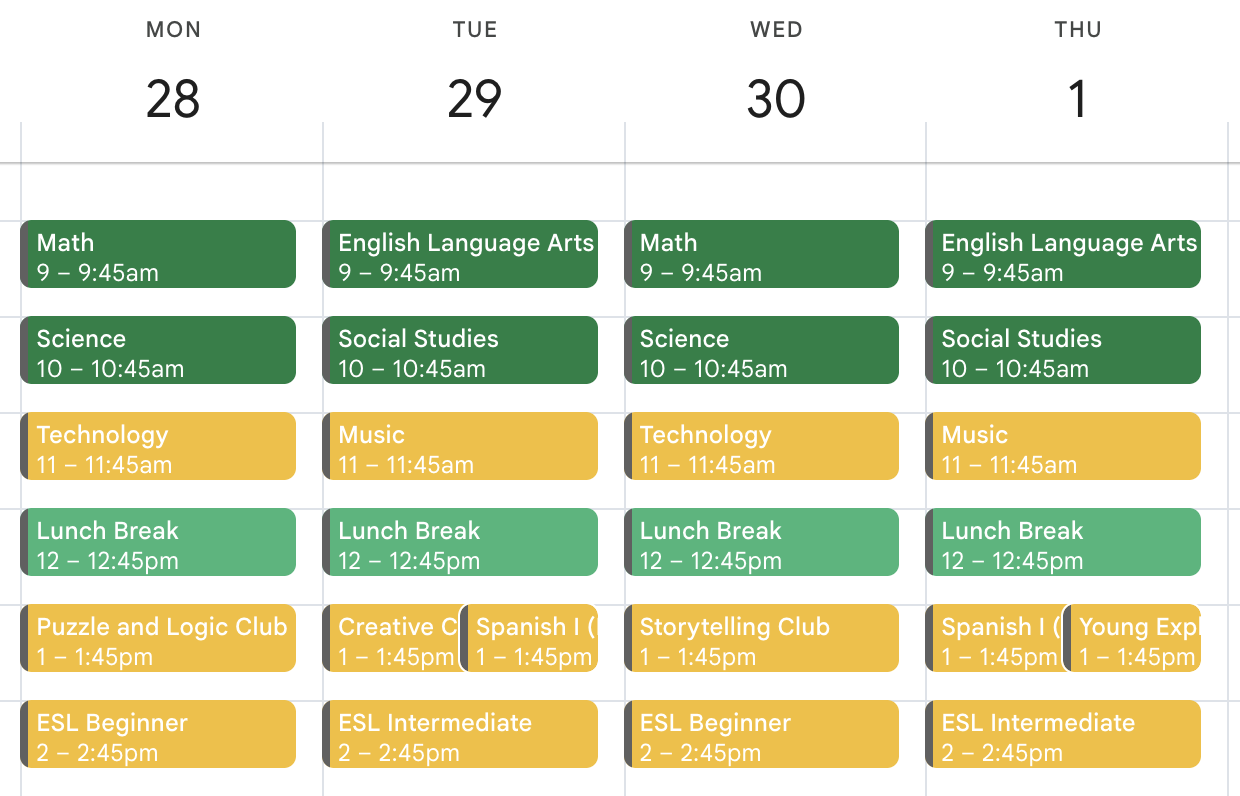
1st Grade Schedule in the approved Legacy Online School weekly schedule format.
10.1.3 2nd Grade Schedule
2nd Grade Schedule in the approved Legacy Online School weekly schedule format.
10.1.4 3rd Grade Schedule
3rd Grade Schedule in the approved Legacy Online School weekly schedule format.
10.1.5 4th Grade Schedule
4th Grade Schedule in the approved Legacy Online School weekly schedule format.
10.1.6 5th Grade Schedule
5th Grade Schedule in the approved Legacy Online School weekly schedule format.
10.1.7 Kindergarten Courses
At Legacy Online School, we believe in providing a nurturing and stimulating learning environment for our youngest learners. Our kindergarten program is designed to foster curiosity, creativity, and a love for learning in every child. Through engaging activities, interactive lessons, and personalized attention, we aim to lay a solid foundation for academic success and lifelong learning.
In this section, you will find information about our kindergarten courses, carefully crafted to meet the developmental needs of children at this crucial stage of their education journey. We offer a comprehensive curriculum that focuses on kindergarten readiness skills and core academic subjects, all delivered through our innovative online platform Buzz.
10.1.7.1 Kindergarten Readiness
Course Overview:
Our Kindergarten Readiness program is designed to provide 4-year-old students with the foundational skills essential for a smooth transition into kindergarten. This comprehensive course, weighing 1 credit, focuses on nurturing young minds across eight crucial domains: Physical Development, Approaches to Learning, Social and Emotional Development, Language and Literacy, Mathematical Thinking, Scientific Inquiry, Social Studies, and Creative Expression Through the Arts.
Key Components:
Holistic Development: The course is crafted to address the needs of the whole child, fostering not only academic growth but also social, emotional, and physical development.
Play-Based Learning: Standards are taught through developmentally appropriate play-based learning, ensuring an engaging and enjoyable educational experience for our young learners.
Research-Based Best Practices: Our curriculum is constructed on research-based best practices, guaranteeing that your child receives a high-quality education designed to meet the latest educational standards.
Preparation for Key Domains: Students will be well-prepared in early literacy, mathematical reasoning, social-emotional skills, physical development, and cognitive abilities, setting a strong foundation for future academic success.
Statewide Kindergarten Screening Readiness: Our program equips students with the skills needed to complete the statewide kindergarten screening, ensuring a confident and prepared start to their formal education journey.
Enroll your child in our Kindergarten Readiness program today, and let's embark on a journey of early education that lays the groundwork for a lifetime of learning!
10.1.7.2 Kindergarten Grade Core Courses
Each of our Kindergarten courses carries the weight of 1 credit, serving as crucial building blocks in your child's educational journey. These foundational courses are meticulously designed to prepare students for the challenges and excitement of higher elementary grades and beyond.
Language Arts: Navigating the Path to Literacy (1 Credit)
Join Penelope the Pirate on an adventure into reading and writing. From alphabet safaris to interactive storybooks, students explore letters, sounds, and words, laying a solid literacy foundation.
Mathematics: Numbers, Shapes, and Real-World Applications (1 Credit)
Engage in dynamic Math exploration, counting, solving real-world problems, and identifying shapes. This course builds a strong mathematical foundation, preparing students for higher-grade challenges.
Science: Foundations Across Disciplines (1 Credit)
Dive into Earth, Life, and Physical Sciences. Hands-on exploration covers the five senses, properties of objects, gravity, day and night sky, and more, fostering a love for scientific wonders.
Social Studies: Connecting to Self, Family, and Community (1 Credit)
Embark on a journey of self-discovery, family exploration, and community understanding. This foundational Social Studies course introduces history, geography, economics, and citizenship concepts.
Spanish: A Cultural and Linguistic Introduction (1 Credit)
Explore the Spanish language and Mexican culture through interactive games and activities. This course builds language skills and fosters an appreciation for cultural diversity.
Arts: Unleashing Creative Potential (1 Credit)
In Art Grade Kindergarten, students embark on a creative journey exploring the elements of art—line, shape, color, value, space, form, and texture. Through interactive practices, videos, and offline activities, students will be inspired to observe the world around them and express themselves through their own artwork. Join us in fostering a lifelong love for the arts!
Computer Science: Nurturing Digital Minds (1 Credit)
Introduce your child to the exciting world of Computer Science in our Kindergarten course. Through age-appropriate content, students develop basic computer skills, grasp fundamental problem-solving concepts, and understand algorithms. Emphasis is also placed on cultivating good digital citizenship habits. Prepare your child for the digital age with our engaging Computer Science curriculum.
Physical Education: Active Bodies, Healthy Habits (1 Credit)
Our Physical Education Kindergarten course focuses on building foundational skills in throwing, catching, kicking, striking, dancing, swimming, and basic gymnastics. Beyond physical skills, students learn about healthy foods, teamwork, and sportsmanship. Through storybooks and interactive activities, students discover the joy of staying active and creating habits that promote a healthy lifestyle. Join us in fostering a love for movement and well-being!
Enroll your child in these credit-worthy courses, setting them on a path of academic success and a lifelong love for learning!
10.1.8 Kindergarten Schedule
Kindergarten Schedule in the approved Legacy Online School weekly schedule format.
10.1.9 Middle School
Middle School Program at Legacy Online School, where we provide an enriching and engaging educational experience for students in grades 6 to 8. Our Middle School Program is thoughtfully designed to empower young learners with the knowledge, skills, and values they need to excel academically and personally.
State-Accredited Curriculum: At Legacy Online School, our Middle School Program follows a state-accredited curriculum that meets the highest educational standards. This curriculum is carefully crafted to challenge and inspire our students while ensuring they receive a well-rounded education with a US Certified Diploma at the end of the program.
Comprehensive Subject Offerings: Our Middle School curriculum encompasses a wide range of subjects to foster a strong academic foundation. Students will explore essential subjects, including:
- Language Arts (Reading, Writing, and Communication Skills)
- Mathematics
- Comprehensive Science
- Social Studies
- Digital Art and Design
- Foreign Languages
- Fitness
- Career Research and Decision Making
STEM Emphasis: We place a significant emphasis on Science, Technology, Engineering, and Mathematics (STEM) education to prepare our students for the challenges of the modern world. Through hands-on activities and engaging projects, students are encouraged to explore the realms of STEM and develop critical problem-solving abilities.
Middle School Curriculum:
https://legacyonlineschool.com/our-curriculum
10.1.10 6th Grade Schedule
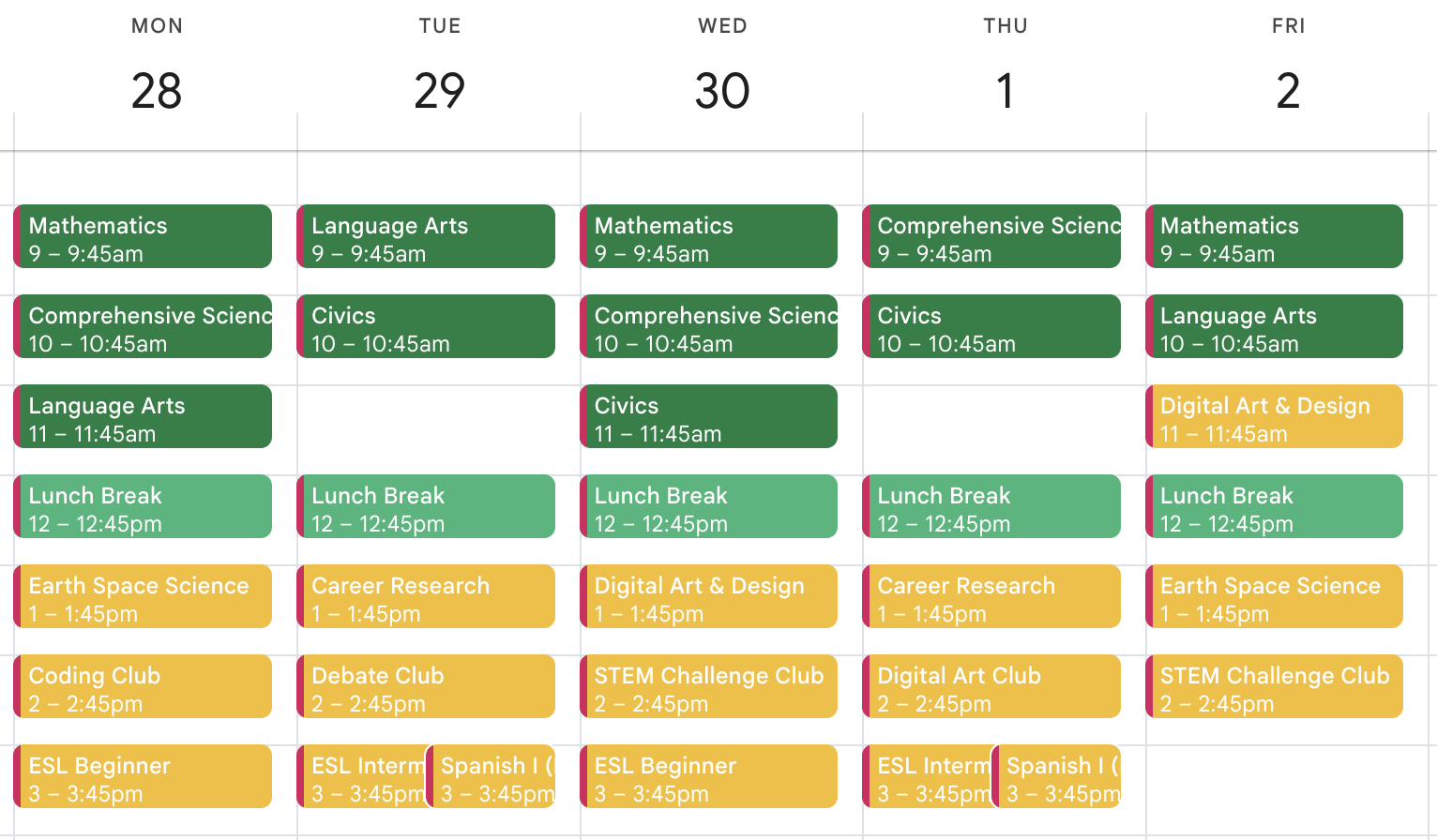
6th Grade Schedule in the approved Legacy Online School weekly schedule format.
10.1.11 7th Grade Schedule
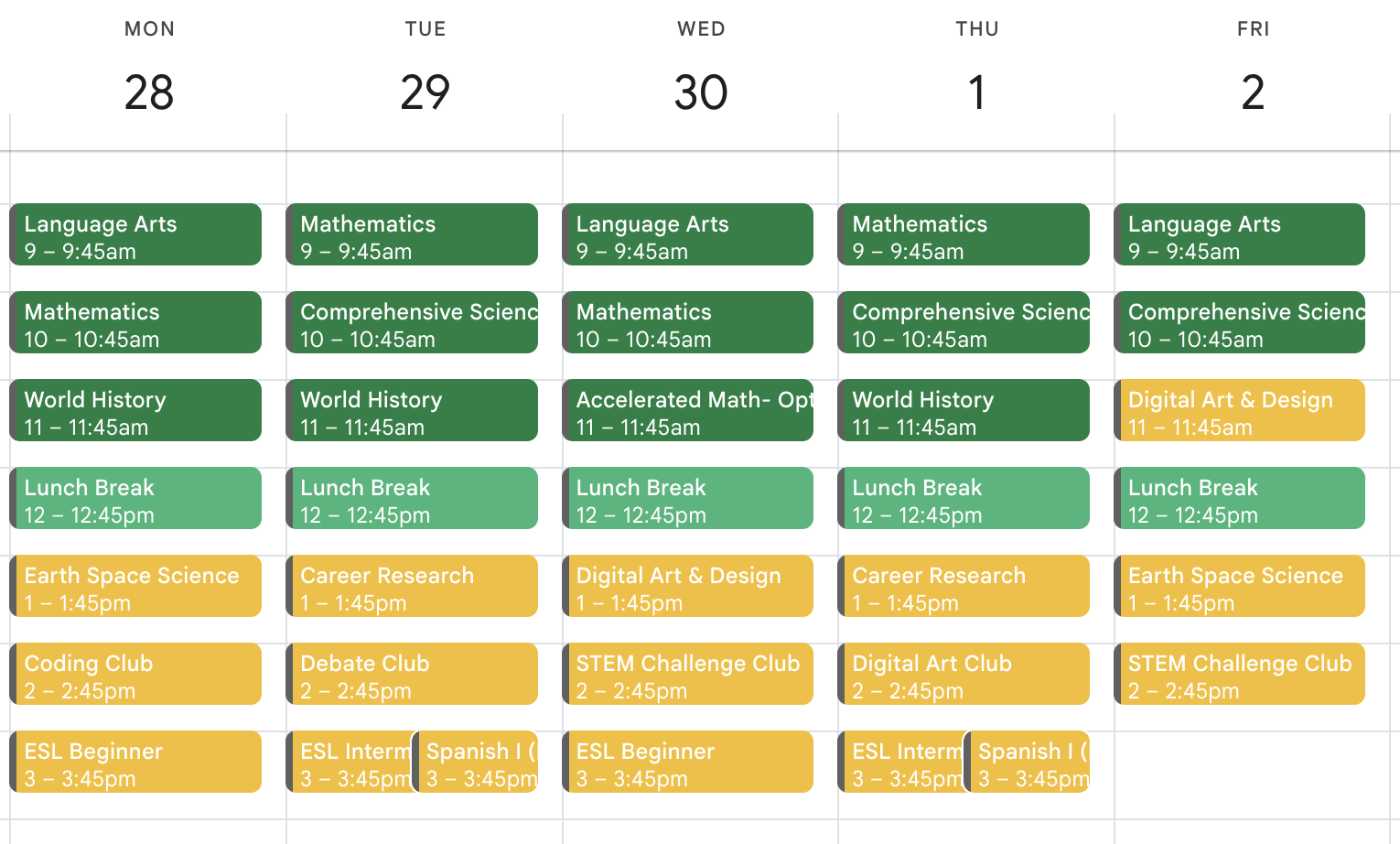
7th Grade Schedule in the approved Legacy Online School weekly schedule format.
10.1.12 8th Grade Schedule
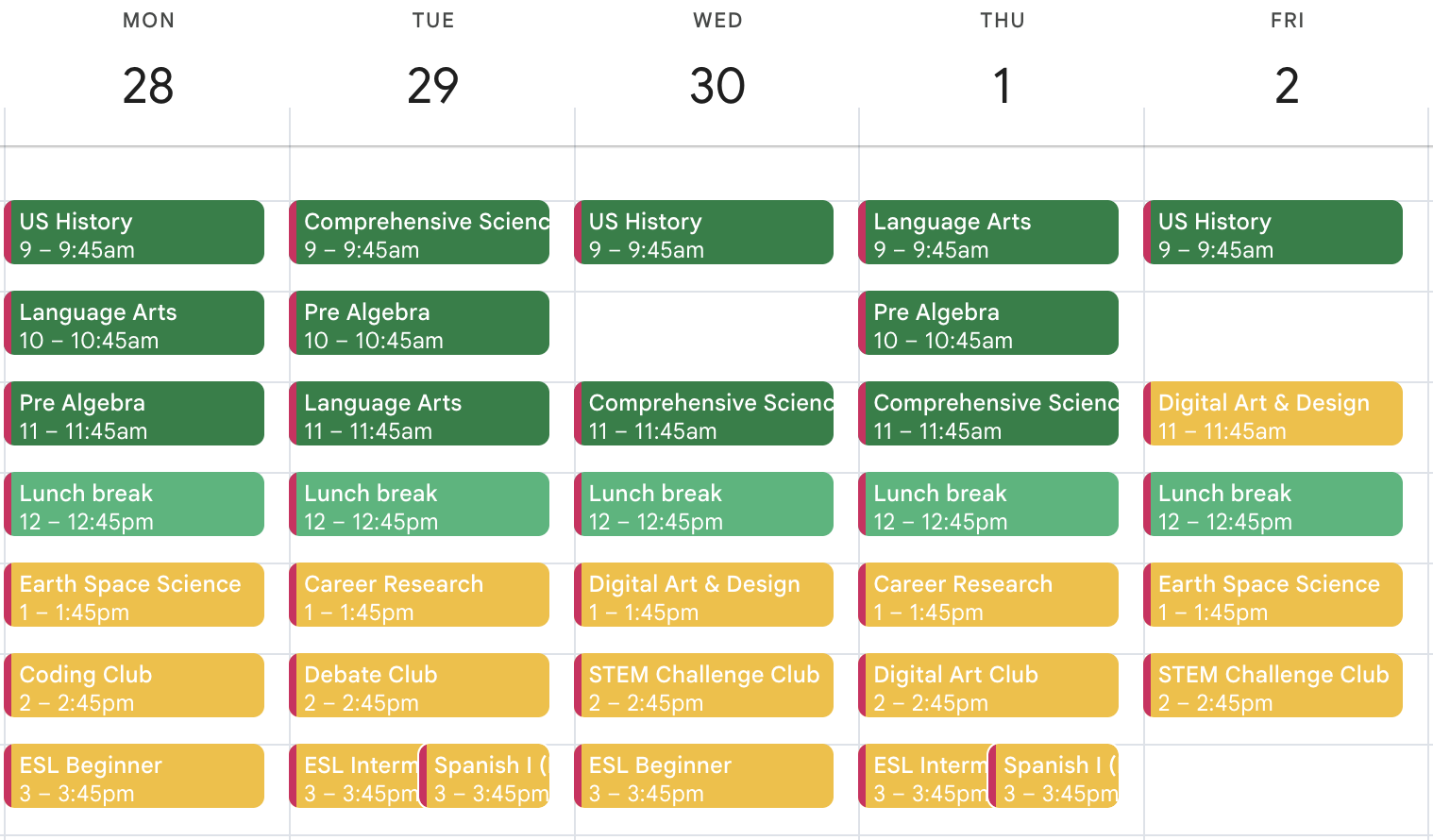
8th Grade Schedule in the approved Legacy Online School weekly schedule format.
10.1.13 High School
The High School Program at Legacy Online School is dedicated to providing a comprehensive and empowering educational experience for students in grades 9 to 12. Our High School Program is designed to prepare students for their future endeavors, whether it be pursuing higher education or entering the workforce with confidence and competence.
State-Accredited Curriculum: At Legacy Online School, our High School Program based on Florida Virtual School Curriculum follows a rigorous state-accredited curriculum that aligns with national educational standards. Our curriculum is carefully designed to challenge and inspire students, equipping them with the knowledge and skills needed to excel in a competitive world. After the requirements’ completion students will receive US Certified Diplomas.
Broad Range of Subjects: We offer a wide array of subjects to cater to the diverse interests and aspirations of our high school students. These subjects include, but are not limited to:
- English Language Arts
- Mathematics (Algebra, Geometry, Calculus, etc.)
- Science (Biology, Chemistry, Physics, etc.)
- Social Studies (World History, U.S. History, Economics, etc.)
- Foreign Languages
- Fine Arts (Visual Arts, Music, Drama, etc.)
- Physical Education
High School Program:
https://legacyonlineschool.com/our-curriculum
10.1.14 9th Grade Schedule
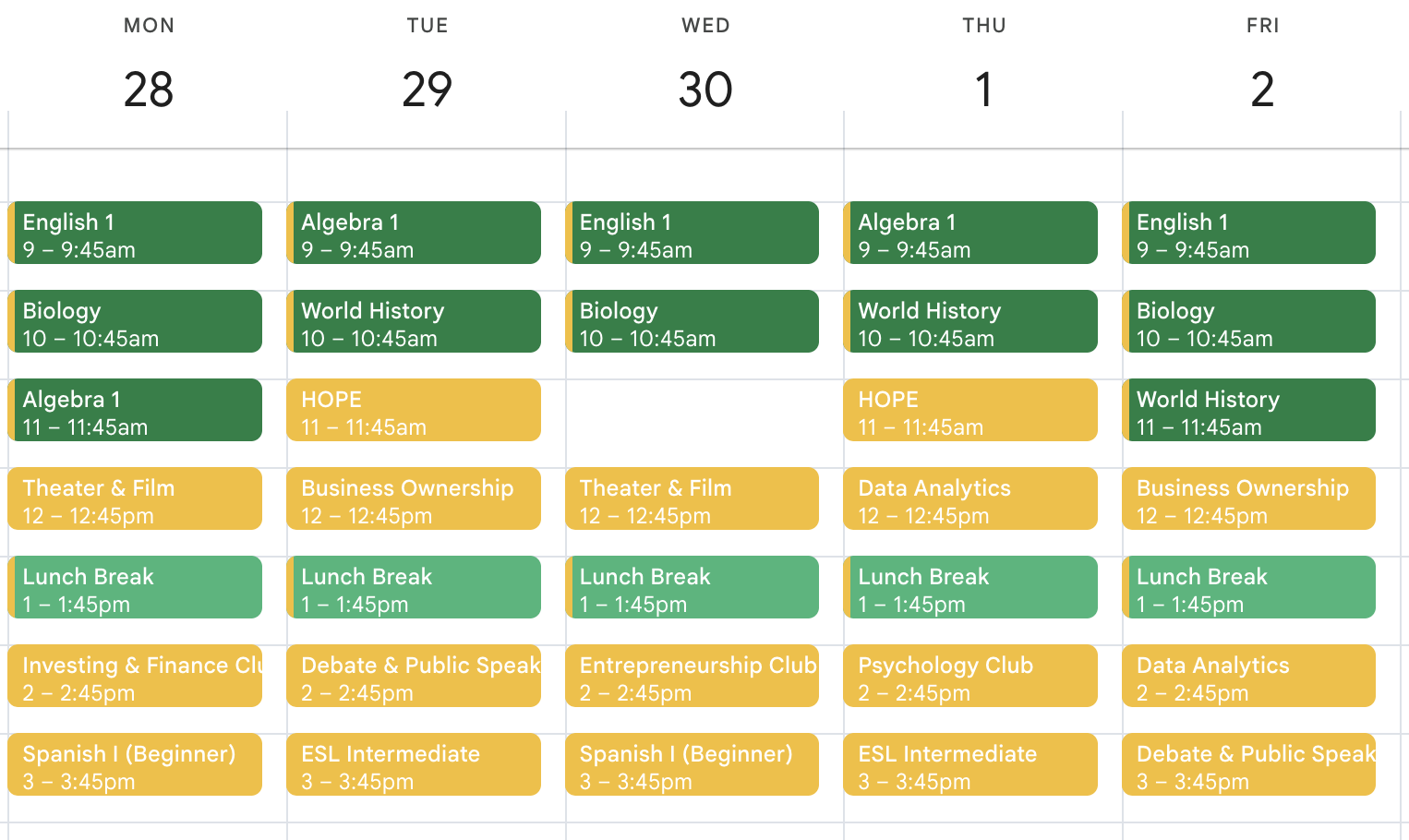
9th Grade Schedule in the approved Legacy Online School weekly schedule format.
10.1.15 10th Grade Schedule
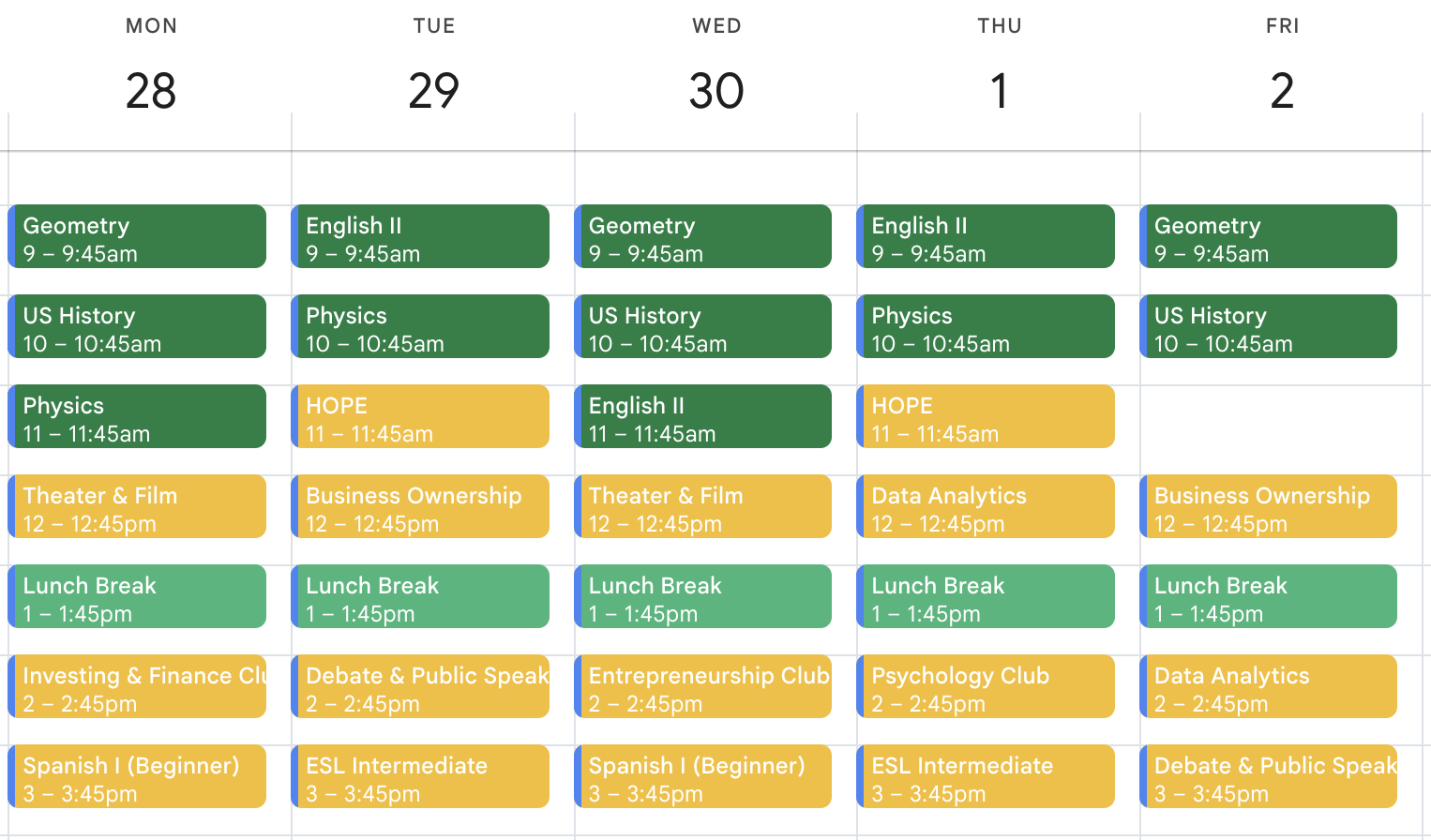
10th Grade Schedule in the approved Legacy Online School weekly schedule format.
10.1.16 11th Grade Schedule
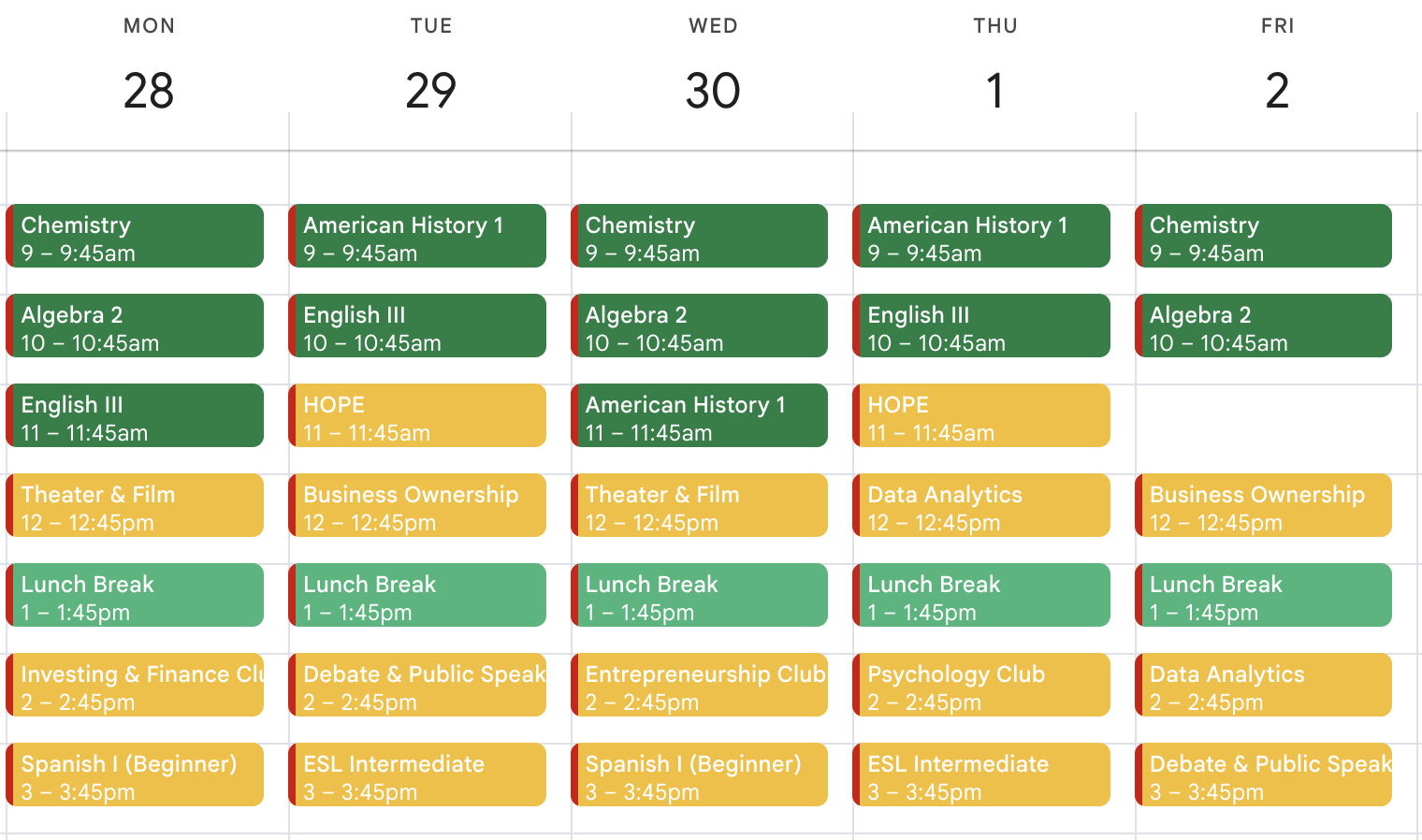
11th Grade Schedule in the approved Legacy Online School weekly schedule format.
10.1.17 12th Grade Schedule
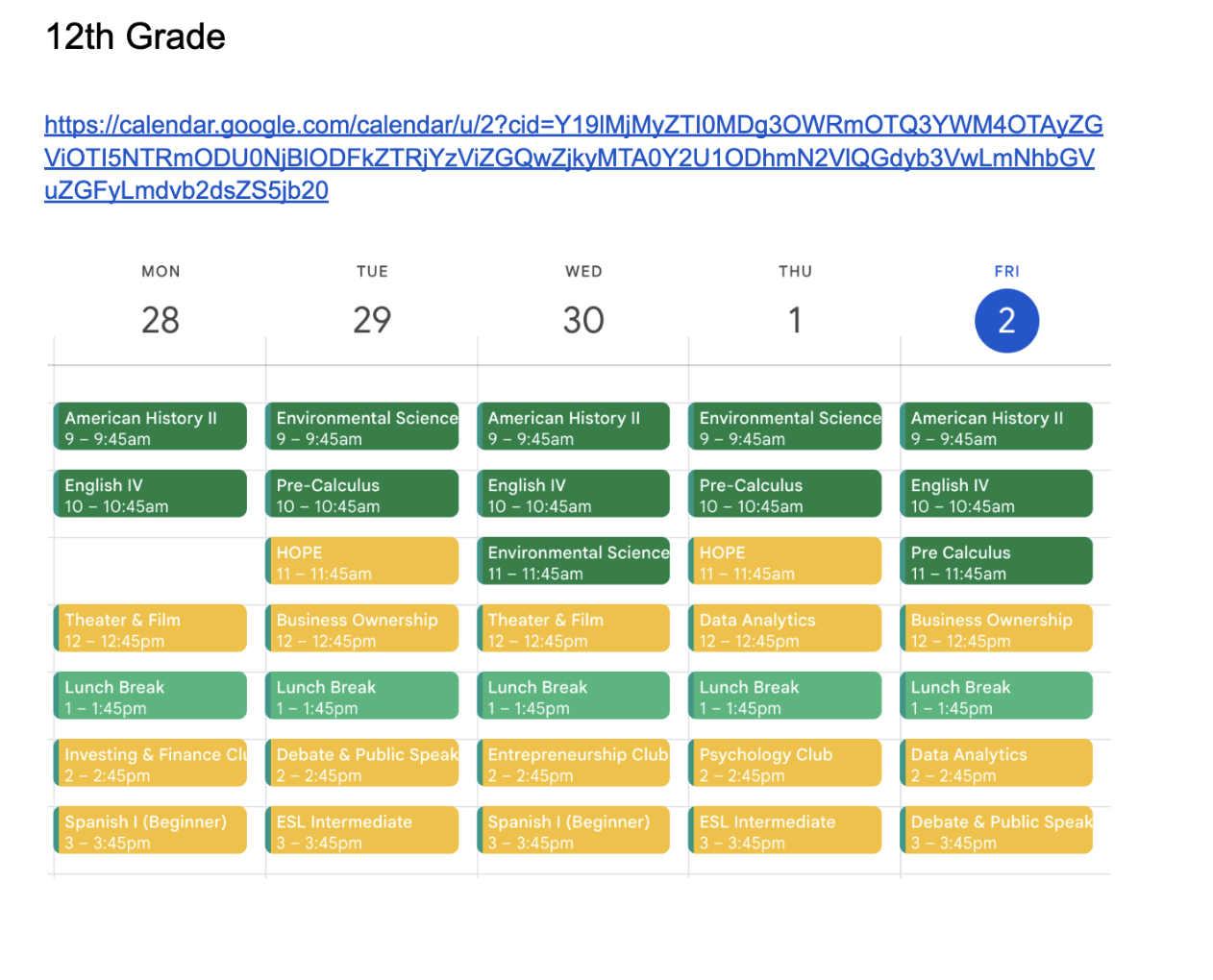
12th Grade Schedule in the approved Legacy Online School weekly schedule format.
10.1.18 Advanced Academic Pathways
Legacy Online School offers advanced academic opportunities for eligible students who are ready for more rigorous coursework. These opportunities may help students strengthen their academic profile and prepare for future college or university study.
Advanced academic pathways may include:
Honors courses
Advanced Placement courses
Dual enrollment opportunities through approved pathways
Academic planning
Graduation audits
Transcript reviews
Course-selection guidance
Placement in advanced coursework depends on student readiness, course availability, prior academic performance, transcript review, and school approval.
10.1.18.1 Honors Courses
Honors courses are designed for students who are prepared for more challenging academic work and who are ready to engage with course material at a deeper level. These courses may move at a more rigorous pace and may require stronger independent study skills, critical thinking, writing, problem-solving, and time management.
Honors courses may be appropriate for students who have demonstrated strong academic performance, consistent effort, and readiness for advanced coursework. Placement in Honors courses may depend on prior grades, teacher recommendation, transcript review, course availability, and approval from the Academic Team.
Honors courses may include a weighted GPA benefit when successfully completed, according to the school’s grading policy. This means that an Honors course may carry a higher GPA value than a standard course because of the increased academic rigor.
Students and families should understand that Honors courses may require additional reading, writing, projects, assessments, or independent work. Students enrolled in Honors courses are expected to keep pace with course requirements and communicate with teachers or Learning Support Specialists if support is needed.
Honors course availability may vary by grade level, subject area, student readiness, and school-year offerings. Final placement in Honors courses is determined by Legacy Online School.
10.1.18.2 Advanced Placement Courses
Legacy Online School is authorized through the College Board AP Course Audit to offer approved Advanced Placement (AP) courses. The College Board is the organization responsible for the AP Program, which allows high school students to complete college-level coursework while still in high school and prepare for AP Exams.
The AP Course Ledger is the official College Board listing of schools and online providers with authorized AP courses. According to the College Board, the AP Course Ledger is the official, up-to-date list of schools and providers whose AP courses have passed the AP Course Audit and are authorized to use the AP designation on student transcripts.
Legacy Online School’s AP courses can be verified through the AP Course Ledger using the school’s CEEB Code: 000114.
AP Course Ledger Verification:
https://apcourseaudit.inflexion.org/ledger/school/ai/000114?roistat_visit=686705
Advanced Placement courses provide students with the opportunity to complete challenging college-level coursework while in high school. AP course availability may vary by school year, student readiness, and College Board authorization.
AP Courses Offered for the 2026–2027 School Year
Legacy Online School plans to offer the following Advanced Placement courses during the 2026–2027 school year:
AP Art History
AP Biology
AP Calculus AB
AP Calculus BC
AP Computer Science A
AP Computer Science Principles
AP English Language and Composition
AP English Literature and Composition
AP Environmental Science
AP Human Geography
AP Macroeconomics
AP Microeconomics
AP Physics 1
AP Precalculus
AP Psychology
AP Spanish Language and Culture
AP Statistics
AP United States Government and Politics
AP United States History
All listed AP courses are available in the Self-Paced Learning Program or through one-to-one live instruction, subject to student readiness, enrollment, teacher availability, and College Board authorization.
AP courses are not offered in the group-learning format for the 2026–2027 school year.
Some AP courses use externally licensed digital textbooks, e-books, access codes, or other course materials. When required, these licenses or materials must be purchased separately by the parent or guardian. Families will be informed of any required additional materials and associated costs before the student begins the course.
Students who enroll in AP courses may also choose to register for AP Exams through the College Board, subject to College Board rules, exam availability, registration deadlines, testing-site procedures, and any applicable exam fees.
The benefits of AP coursework and College Board authorization include:
College-Level Coursework: Through the AP program, students may enroll in challenging college-level courses while still in high school.
College Admissions Advantage: Strong performance in AP courses and examinations can enhance university applications and demonstrate academic readiness.
Access to Educational Resources: College Board authorization supports access to curriculum resources, professional development opportunities for teachers, and guidance for implementing advanced coursework.
Preparation for Higher Education: Students gain experience with rigorous academic expectations that help prepare them for university-level study.
Transcript Recognition: Authorized AP courses may be listed with the official AP designation on student transcripts, subject to College Board authorization and school policy.
10.1.18.3 Dual Enrollment
Legacy Online School supports eligible high school students who wish to pursue approved college-level coursework while completing their high school diploma requirements.
Dual enrollment may allow students to earn college credit and, when approved, high school credit at the same time. These opportunities can expand course options, introduce students to college-level expectations, and may help students begin completing general education requirements commonly required by colleges and universities.
Legacy Online School may offer or support dual enrollment opportunities through approved pathways such as Arizona State University (ASU) and the University of South Florida (USF). Students may also request approval to take courses through a local community college or other accredited college, subject to review.
10.1.18.4 Eligibility and Approval
To participate in dual enrollment for high school credit, students must generally be enrolled as full-time Legacy Online School students, carrying a full-time course load of approximately 5–6 credits/courses.
Dual enrollment participation is subject to:
Student eligibility
Academic standing
Course availability
College or university admission requirements
Legacy Online School approval
Parent/guardian approval, if applicable
Submission of official college transcripts after course completion
10.1.18.5 Credit Transfer Guidelines
College courses must be reviewed and approved before they can be added to a Legacy Online School transcript.
General guidelines include:
College courses must be from an accredited institution.
Courses must be approved as appropriate for high school credit.
Dual-enrollment coursework is evaluated using the Florida Department of Education Dual Enrollment Course—High School Subject Area Equivalency List in effect at the time of review. A 3-credit college course may be eligible for 0.5 or 1.0 high school credit depending on the published equivalency, subject area, course content, and the student’s graduation requirements.
Students may take a maximum of 2 approved college courses per grade level for transfer credit, unless an exception is approved.
Official college transcripts must be submitted before credits can be posted to the Legacy transcript.
Final credit placement is determined by Legacy Online School after transcript and course review.
10.1.18.6 ASU and USF Dual Enrollment
Legacy Online School supports dual enrollment opportunities through Arizona State University (ASU) and the University of South Florida (USF) for eligible students.
Available courses, pricing, registration procedures, timelines, and eligibility requirements may vary by university and program. Families interested in dual enrollment should contact their Learning Support Specialist (LSS) for guidance before registering for any college course.
Contact: mena.lss@legacyonlineschool.com
10.1.19 College and Career Advising
Legacy Online School provides college and career advising to help students make informed academic decisions and prepare for future educational and career goals.
Students may receive support with:
Graduation audits
Credit reviews
Transcript evaluations
Academic planning
Course selection
Advanced-course planning
College-readiness guidance
General university preparation
Career pathway discussions
College and career advising is intended to support planning and preparation. Admission decisions, scholarship decisions, credit acceptance, and program eligibility are determined by the receiving college, university, scholarship organization, or external institution.
10.1.19.1 College Guidance Packages
In addition to general college and career advising, Legacy Online School may offer optional College Guidance Packages for students who would like more personalized support with college planning, applications, essays, test preparation, and admissions strategy.
These packages are optional and are available for an additional fee. Current pricing, package availability, and service details are listed in the school’s official fee schedule or college guidance materials.
Available packages may include:
10.1.19.2 College Prep Foundations
This package is generally best for students in Grades 9–10 who are beginning to prepare for college early.
Support may include:
One-on-one academic consulting sessions
Personalized college preparation roadmap
Career exploration
Strengths and interest discovery
Extracurricular planning
Independent project planning
Competitive summer program preparation
Small-group workshops
Introductory test preparation support
10.1.19.3 College Application – Essential
This package is generally best for students in Grades 11–12 who are beginning the college application process and need structured support.
Support may include:
Application strategy sessions
College list development
Essay planning and review
Activity and honors list review
Letter of recommendation strategy
Overall application review
Group workshops on application storytelling, activities, > scholarships, and college financing
Private test preparation support
10.1.19.4 College Application – Premium
This package is generally best for students in Grades 11–12 who need more in-depth, personalized support over a longer period.
Support may include:
One-on-one strategy sessions
Progress check-ins
Application calendar planning
College list review
Essay development and multiple rounds of feedback
Activity and honors list strategy
Letter of recommendation planning
Interview preparation
Financial aid guidance
Group workshops
Private test preparation support
10.1.19.5 College Application – Elite
This package is generally best for students in Grades 10–11 who want comprehensive, long-term college preparation and application support.
Support may include:
Long-term college planning
Independent project support
Competitive summer program application support
College and major selection
Master application timeline
Unified application story development
Personal statement and supplemental essay support
Extensive college list planning
Activities, honors, and recommendation strategy
Honors college application support
Interview preparation
Financial aid guidance
Private tutoring or test preparation support
10.1.19.6 Lite College Application Review
This option is generally best for students in Grades 11–12 who need a focused review of one college application.
Support may include:
One-time recorded video review
Feedback on one school application
Review of personal statement
Review of one supplemental essay
Activity list review
Honors and awards review
Additional information section feedback
10.1.19.7 SAT / ACT Test Preparation
Legacy Online School may offer SAT and ACT test preparation options for students preparing for standardized college admissions exams.
Test preparation may be available through:
Private one-on-one tutoring
Small-group prep courses
Customized study plans
Practice assignments
Practice tests
Real-time feedback
Targeted support in weaker subject areas
Private tutoring may be scheduled by the hour, depending on student needs and tutor availability. Small-group SAT/ACT prep courses may also be offered when available and may include live sessions, homework assignments, practice testing, and collaborative instruction.
10.1.19.8 Fees and Availability
College guidance packages, application support, and SAT/ACT preparation services are optional and are not included in standard tuition unless specifically stated in the student’s enrollment plan.
Fees, package contents, duration, number of sessions, and availability are subject to change. Families should refer to the current fee schedule or contact the Learning Support Specialist team for the most up-to-date information.
Contact: mena.lss@legacyonlineschool.com
10.2 Part-Time Group Learning Program
The Part-Time Group Learning Program is designed for students who do not need a full course load but still want access to live teacher-led classes and structured academic support.
Part-time students take a reduced course load. This option may be suitable for students who are homeschooled, enrolled in another school, completing supplemental coursework, or looking for support in selected subjects.
The Part-Time Group Learning Program may include:
A reduced number of courses
Live online classes in selected subjects
Teacher instruction and support
Access to the learning platform
Assignments and grading for enrolled courses
Academic progress monitoring for selected classes
Part-time enrollment does not automatically lead to a Legacy Online School diploma unless the student later enrolls full-time and completes all Legacy graduation requirements.
This program is best for families who need live instruction in specific subjects but do not need a complete full-time program.
10.3 Self-Paced Learning Program
The Self-Paced Learning Program offers a structured and flexible option for students who prefer to complete coursework according to an independent schedule. Courses are designed to be completed within the academic year; however, the self-paced format gives students flexibility in how they organize and progress through their coursework. Students may move ahead more quickly when they demonstrate readiness and successfully complete all required assignments and assessments.
Students receive access to the school’s online learning platform, including lessons, instructional materials, activities, quizzes, assignments, assessments, and progress-monitoring tools. The program does not include daily live teacher-led classes.
Teacher Support
Teachers provide academic support through the learning platform, including:
Answering course-related questions
Reviewing and grading submitted work
Providing feedback on assignments and assessments
Monitoring academic progress
Offering guidance when students experience difficulty
Students are expected to access the learning platform regularly, review teacher feedback and school communications, submit original work, and make satisfactory progress toward completing their courses.
Individual Consultation Sessions
Each self-paced student is eligible for two complimentary 30-minute individual consultation sessions per month with a self-paced instructor. These sessions may be used to:
Ask questions about course content
Review challenging concepts
Discuss assignment feedback or academic progress
Receive guidance on current or upcoming coursework
To request a consultation, the student or parent/guardian must email self-paced.mena@legacyonlineschool.com and include:
The student’s full name
The student’s grade level
The course for which support is requested
A brief description of the topic or assistance needed
The student’s general availability
The Self-Paced Learning Team will respond with the appropriate instructor’s available meeting times. Consultations must be scheduled in advance and are subject to instructor availability.
These consultations provide focused academic guidance and are not a substitute for daily instruction, ongoing tutoring, or the student’s responsibility to complete assigned coursework.
Additional Tutoring
Families seeking support beyond the two monthly consultations may purchase additional individual tutoring at the school’s current rate of $25 per hour. Tutoring sessions are subject to instructor availability and the school’s scheduling procedures.
Student and Family Responsibilities
Students are responsible for participating consistently, completing all required coursework and assessments, monitoring their progress, and requesting assistance when needed.
Parents or guardians are expected to provide age-appropriate supervision, help the student establish a consistent learning routine, monitor progress, and maintain communication with the school.
The Self-Paced Learning Program is best suited for students who can work with an appropriate level of independence and for families seeking greater scheduling flexibility within a structured, school-supported academic program.
10.4 One-on-One Live Teaching Program
The One-on-One Live Teaching Program provides individualized instruction between the student and teacher.
This program is designed for students who need personalized attention, a custom pace, direct teacher support, or a learning environment tailored to their academic needs.
The One-on-One Program may include:
Private live classes with a teacher
Customized learning pace
Flexible scheduling where available
Direct teacher instruction
Personalized academic support
Focus on student-specific strengths and challenges
Support for students who need more attention than a group class can > provide
This program is suitable for students who may need a more individualized approach, including students who require additional academic support, advanced pacing, schedule flexibility, or a quieter learning environment.
10.5 IEP Group Learning Programs
Legacy Online School offers IEP learning support options for students with documented learning needs, including students with an Individualized Education Program or similar support plan.
Support may vary depending on the student’s needs, program selection, documentation provided, and available services.
Learning support may include:
Small-group instruction
Modified instructional pacing
Teacher support
Academic accommodations where applicable
Progress monitoring
Parent communication
Supportive learning environment
Families should provide all relevant documentation, including IEPs, evaluations, accommodation plans, or prior school records, so the Academic Team can review the student’s needs and recommend the most appropriate placement.
Program Structure:
Certified IEP Teachers: Our specially trained teachers will lead separate groups for students with IEPs, ensuring they receive the attention and support they need.
Independent Study: Students will utilize materials available in Buzz and study independently. However, teachers will guide them through the learning process and clarify any necessary questions.
Weekly Interaction: Each student will have 10-12 hours per week of dedicated time with their teacher. During these sessions, they will discuss each subject and review some topics in class. Most of the coursework will be completed independently.
Personalized Support: Teachers will focus closely on each student, preparing accommodations to help them succeed. This includes modifying assignments, providing additional resources, and offering tailored guidance to meet each student's individual learning requirements.
*At this time, we do not work with non-verbal students, and all students must be able to communicate verbally to participate in the program.
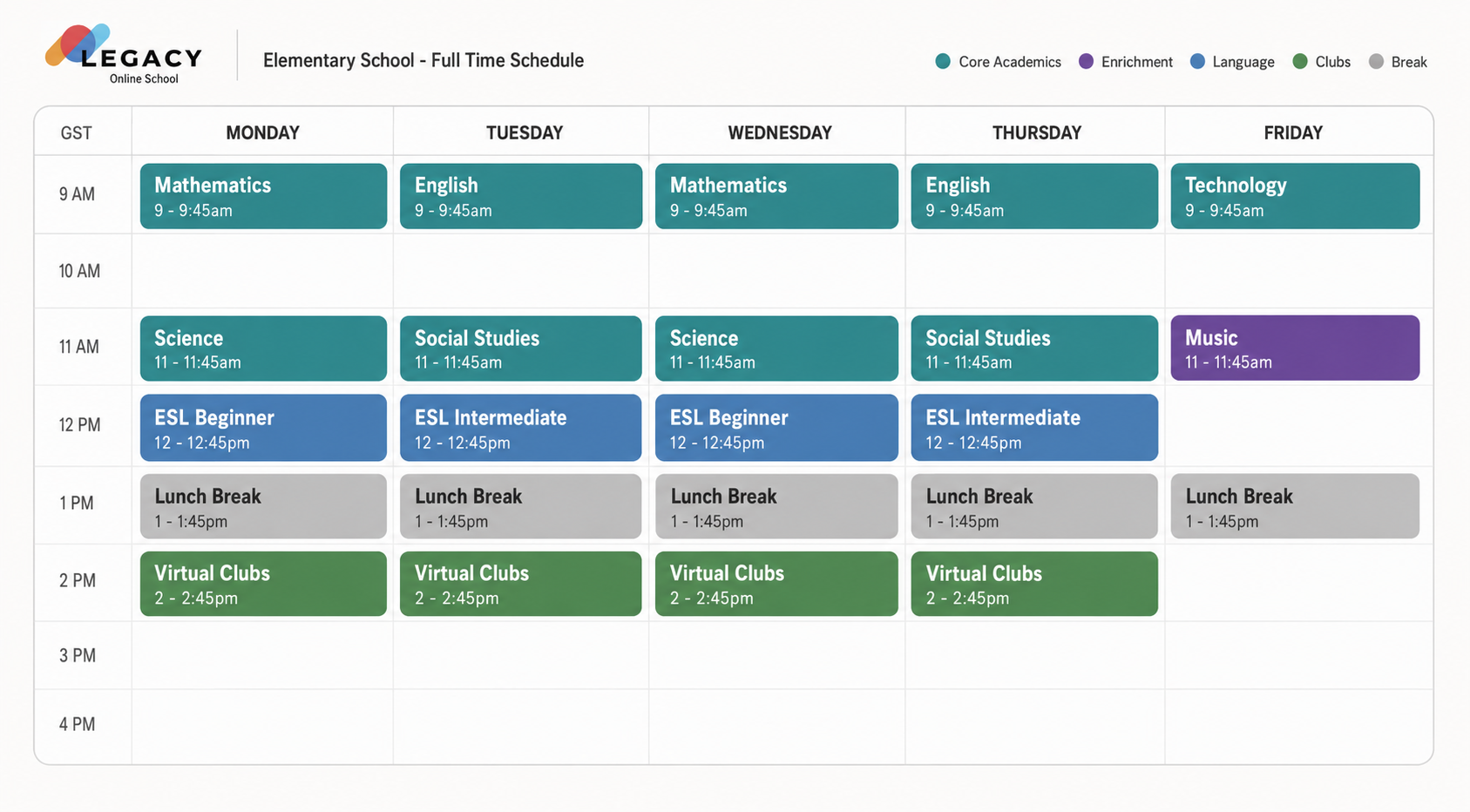
Elementary School IEP Schedule:
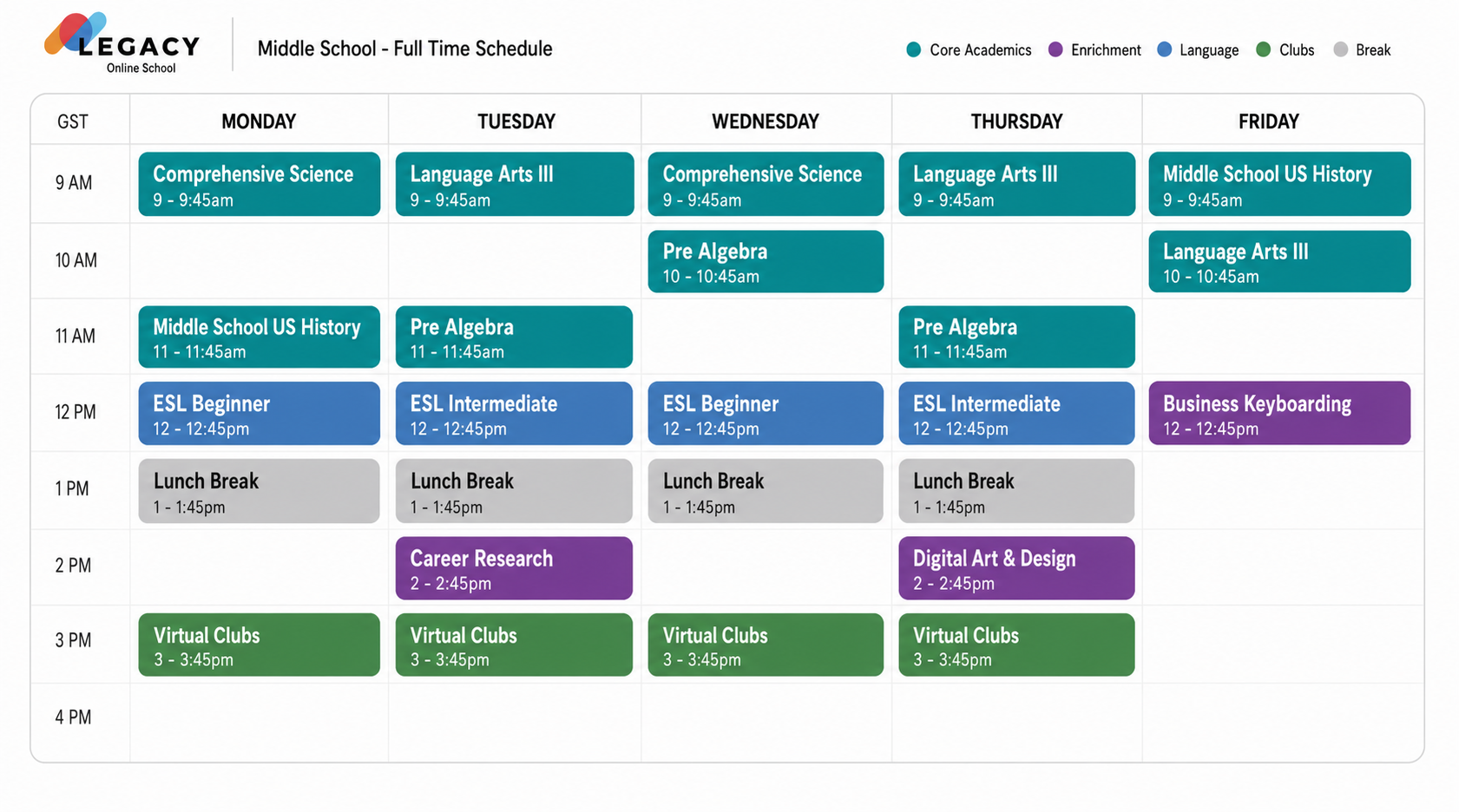
Middle School IEP Schedule:
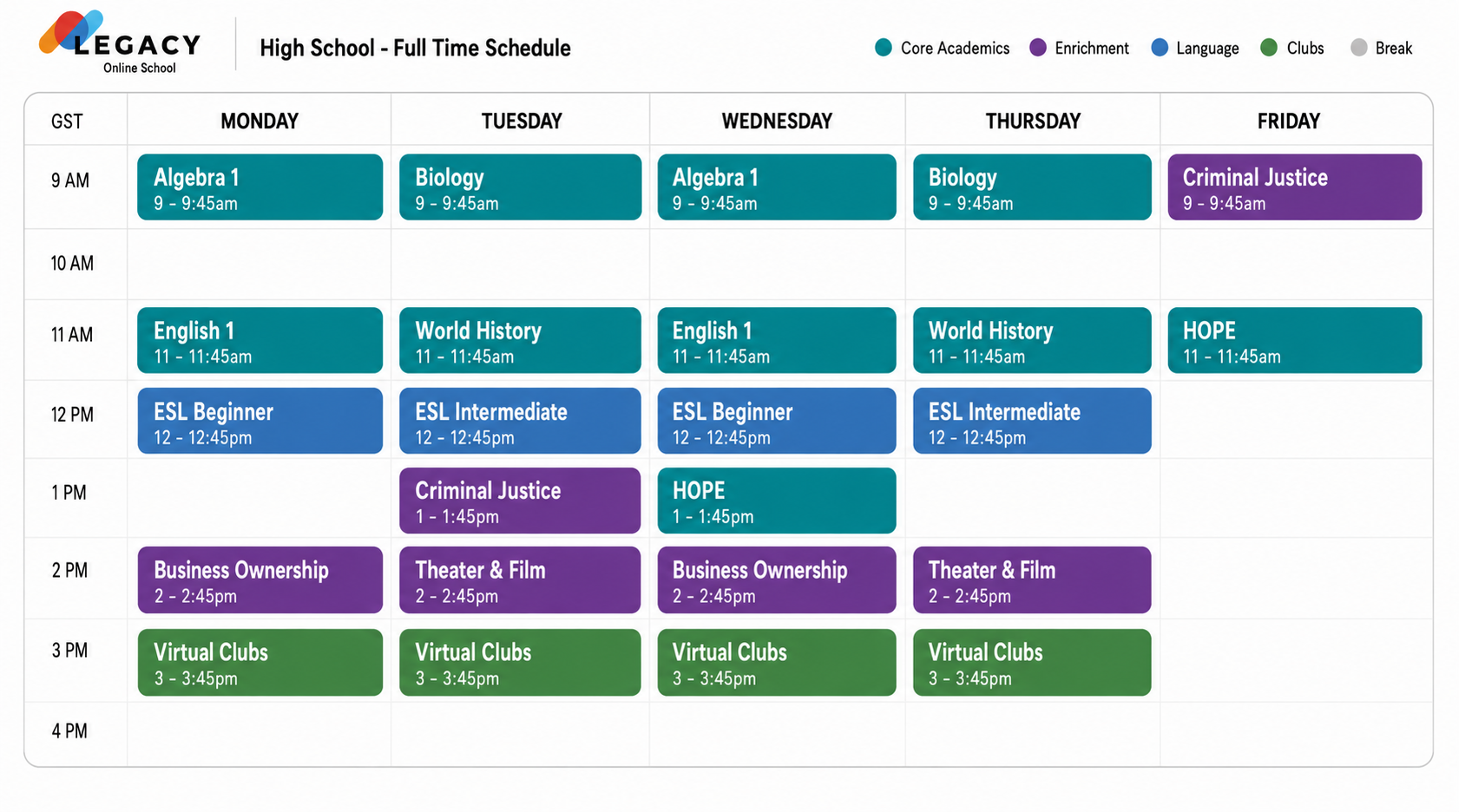
High School IEP Schedule:
Our goal is to ensure that all students, regardless of their educational needs, have the opportunity to thrive academically.
10.5.1 Materials and Supplies for Courses
To ensure students are fully prepared for their courses, we have compiled comprehensive lists of required materials for each school level — Elementary, Middle, and High School. These lists outline the essential supplies needed to complete assignments, participate in activities, and stay organized throughout the academic year.
Elementary School Materials List:
Middle School Materials List:
High School Materials List:
10.6 Summer School Programs
Legacy Online School may offer Summer School programs for students who need to catch up, complete missing work, recover credit, prepare for the next grade level, or continue academic progress during the summer.
Summer School options may vary by grade level, subject availability, and program structure.
Summer School may include:
Core academic subjects
Credit recovery options
Skill review
Teacher support
Flexible or live class options depending on the program
Academic preparation for the next school year
Summer School does not always reflect the full regular school-year experience, as summer programs may have different schedules, class sizes, subject offerings, and instructional formats.
10.7 International Grade Placement and Academic Pathways
Legacy Online School recognizes that educational systems vary significantly from country to country. Students entering from international schools may have different academic experiences, curriculum exposure, and grade-level expectations than students enrolled in traditional American schools.
For this reason, grade placement decisions may be based on a combination of factors, including:
Previous academic records
Placement assessment results
Teacher evaluations
Student age
English language proficiency
Curriculum alignment with U.S. academic standards
Transcript or report card review
Academic Team recommendation
Students may occasionally be placed in a grade level that differs from their previous school placement if it is determined that doing so will better support their academic success.
10.7.1 American Curriculum Framework
Legacy Online School follows an accredited American curriculum aligned with U.S. academic standards.
10.7.1.1 Elementary School
Elementary students develop foundational skills in:
English Language Arts
Reading
Writing
Mathematics
Science
Social Studies
Art
Technology
Physical Education
At Legacy Online School, the Elementary School Program is designed to provide young learners with a strong foundation for their academic journey. The curriculum is carefully structured to foster intellectual curiosity, critical thinking, and a love for learning.
Elementary students are introduced to core academic subjects while also developing communication skills, problem-solving skills, creativity, and confidence.
10.7.1.2 Middle School
Middle school students build upon these foundations through:
Advanced Language Arts
Mathematics
Science
Social Studies
Elective exploration
Technology integration
Critical thinking
Research skills
Independent study habits
Middle school prepares students for the academic expectations of high school by helping them strengthen organization, responsibility, and subject-area knowledge.
10.7.1.3 High School
High school students complete graduation requirements through a combination of core academic courses and electives while preparing for college, career, and future educational opportunities.
High school coursework may include:
English
Mathematics
Science
Social Studies
World Languages
Fine Arts or Practical Arts
Physical Education
Electives
Honors courses
Advanced Placement courses, where available
High school students may also receive transcript review, graduation planning, and academic advising to help them remain on track for diploma completion.
10.7.2 Educational Flexibility
Legacy Online School offers multiple educational pathways to meet the needs of diverse learners.
These include:
Full-Time Live Instruction Programs
Part-Time Live Instruction Programs
Self-Paced Learning Programs
One-on-One Instruction Programs
Learning Support and IEP Programs
Summer School Programs
This flexibility allows families across different countries and time zones to select the learning model that best meets their educational goals, academic needs, and scheduling requirements.
11. School Calendar, Hours, and Time Commitment
11.1 Academic calendar 2026 to 2027
Sep 7, 2026 - First Day of Classes
Sep 28, 2026 - Virtual Clubs, ESL and Spanish Courses Begin
Oct 26 – Nov 1, 2026 - Autumn Break
Nov 30, 2026 - UAE Commemoration Day
Dec 1 – 3, 2026 - UAE National Day (Eid Al Etihad)
Dec 14 – 18, 2026 - 1st Semester Exam Period
Dec 21 – 25, 2026 - 1st Semester Exam Retake Period
End of Dec, 2026 - Distribution of Fall Semester Report Cards
Dec 28, 2026 – Jan 10, 2027 - Winter Break
Jan 1, 2027 - New Year's Day
Jan 11, 2027 - Classes, Clubs, ESL and Spanish Resume
Feb 26, 2027 - Elementary School Virtual Field Trip
Mar 10 – 12, 2027 - Eid Al Fitr (projected)
Apr 5 – 11, 2027 - Spring Break
May 15, 2027 - Arafat Day (projected)
May 16 – 18, 2027 - Eid Al Adha (projected)
June 4, 2027 - Last Day for Virtual Clubs
Jun 14 – 18, 2027 - 2nd Semester Exam Period
Jun 21 – 25, 2027 - 2nd Semester Exam Retake Period
Jun 29, 2027 - Last Day of Classes
End of June 2027 - Distribution of Spring Semester Report Cards
Jul 9, 2027 - Graduation Ceremony
11.1.1 UAE Public Holidays
Legacy Online School observes UAE public holidays where applicable to the regional academic calendar. UAE public holidays may include both fixed-date national holidays and Islamic holidays.
Fixed-date UAE holidays include Nov 30 (Commemoration Day), Dec 1–3 (National Day), and Jan 1 (New Year's Day).
Islamic holidays include Mar 10–12 (Eid Al Fitr), May 15 (Arafat Day), and May 16–18 (Eid Al Adha). These dates are subject to official UAE announcements and moon sighting, and may be adjusted by the relevant authorities.
*Islamic holiday dates are tentative and subject to official UAE confirmation and moon sighting. Families should refer to the final academic calendar and official school communications for confirmed school closure dates.
11.2 Support Hours and Response Times
School support is available Monday through Friday, during regular school business days. Recommended support hours are 9:00 AM to 5:00 PM GST.
Families may contact the school for assistance with academic questions, scheduling, class links, attendance, course access, teacher communication, curriculum questions, credits, transcripts, and general student support.
The school aims to respond to family messages within one business day. Response times may vary during weekends, holidays, school breaks, high-volume periods, or when a request requires review by multiple departments.
To help the school respond efficiently, families should include the student’s full name, grade level, program, course name if applicable, a clear description of the issue, and any relevant screenshots or documents.
General Groups
High School (9-12): grouplearning.high@legacyonlineschool.com
Middle School (6-8): grouplearning.middle@legacyonlineschool.com
Elementary School (K-5):
grouplearning.elementary@legacyonlineschool.com
IEP Groups
Elementary School IEP (K-5):
iepgrouplearning.elementary@legacyonlineschool.com
Middle School IEP (6-8):
iepgrouplearning.middle@legacyonlineschool.com
High School IEP (9-12): iepgrouplearning.high@legacyonlineschool.com
Self-Paced
All Grade Levels: self-paced.mena@legacyonlineschool.com
Messages received outside regular support hours may be reviewed on the next business day. Families can also use the live chat on the School Platform at any time: the virtual assistant answers common questions straight away, and a member of the Learning Support team replies during support hours. See Section 41.9. The Learning Support team can also be reached by phone or WhatsApp at +962 (79) 508-76-90.
11.3 Weekly Time Commitment
Students are expected to dedicate consistent time each week to live classes, coursework, assignments, reading, projects, assessments, and independent study.
The expected weekly time commitment may vary depending on the student’s grade level, program type, course load, pacing, academic needs, and whether the student is enrolled in standard, Honors, Advanced Placement, dual enrollment, self-paced, or support-based courses.
As a general guideline, students should expect the following weekly time commitment:
| Grade Level | Approximate Weekly Time Commitment |
|---|---|
| Elementary School | 15–20 hours per week |
| Middle School | 20–25 hours per week |
| High School | 25–30 hours per week |
Students enrolled in Honors, Advanced Placement, dual enrollment, credit recovery, or additional support courses may need more time each week. Self-paced students may have more flexibility when they complete coursework, but they are still expected to make steady academic progress.
Families are encouraged to help students maintain a regular study routine, attend scheduled classes, complete assignments on time, and communicate with teachers or Learning Support Specialists when additional support is needed.
12. Academic Program and Curriculum
Legacy Online School offers a standards-based curriculum for kindergarten through grade twelve, including core subjects, electives, honors and Advanced Placement courses, dual-enrollment opportunities through approved partners, courses for students with an Individualized Education Program, and courses in other languages where offered.
https://legacyonlineschool.com/our-curriculum
12.1 Curriculum
Our courses are designed by Florida Virtual School (FlexPoint Education Cloud), ensuring a high-quality, state-approved curriculum. The benefits of this partnership include:
Accredited Curriculum: Our courses meet the rigorous standards set by educational authorities, ensuring your education is recognized and respected.
Diverse Course Offerings: With a wide range of subjects and elective options, students can tailor their education to their interests and career goals.
Up-to-Date Content: Regular updates to course materials ensure that students receive the most current and relevant information.
At Legacy Online School, we are proud to offer the Florida State Virtual School (FLVS) Curriculum to our students. The FLVS Curriculum is a state-accredited program designed to provide a comprehensive and high-quality education for K-12 students in the state of Florida. As an online school, we are dedicated to delivering excellence in education, and partnering with FLVS allows us to uphold the highest standards of academic rigor and innovation.
- State-Accredited Excellence: The FLVS Curriculum is accredited by the state of Florida, ensuring that our students receive a top-notch education that aligns with the state's educational standards. This accreditation demonstrates our commitment to providing a reputable and credible learning experience.
- Comprehensive Subject Offerings: The FLVS Curriculum offers a broad range of subjects across grade levels, catering to the diverse interests and learning needs of our students. From core subjects such as Mathematics, Language Arts, Science, and Social Studies to elective courses in areas like Fine Arts, Foreign Languages, and Career and Technical Education, students have access to a well-rounded education that fosters academic and personal growth.
- Emphasis on STEM Education: The FLVS Curriculum places a special emphasis on Science, Technology, Engineering, and Mathematics (STEM) education. Through innovative and interactive learning experiences, students are encouraged to explore the exciting world of STEM and develop essential problem-solving and critical thinking skills.
At Legacy Online School, our partnership with FLVS ensures that our students have access to a high-quality education that prepares them for future success. The FLVS Curriculum, combined with our dedicated teachers and personalized learning approach, creates a unique and enriching learning experience that empowers students to achieve their full potential.
Digital Version of the Curriculum:
https://www.flvs.net/curriculum
12.2 Academic Progress Reporting
Legacy Online School uses assignment grades/scores/rubrics, narrative evaluations, and direct teacher to parent/student communication to describe a student's academic progress. We provide detailed monthly academic progress reports to parents and students. The reports offer insights into a student's strengths, areas for improvement, and overall progress.
Additionally, teachers are readily available for parent-teacher conferences to discuss individual student performance and address any concerns or questions. That is why parents are welcome and encouraged to contact staff at any time to discuss their child's progress, but they can always check it through LMS from an ‘observer/parent/guardian’ account, where they can view grades, attendance records, and teacher feedback in real-time. A live digital version of the students progress is available on request.
The link to the online portal is the following:
https://legacy.agilixbuzz.com/student/home/courses
12.2.1 Grading Policy
At Legacy Online School, we believe in fair and transparent grading practices that accurately assess students' academic performance and provide valuable feedback on their progress. Our grading policy is designed to promote a positive learning experience and encourage continuous improvement. Here are the key components of our grading policy:
- Grading Scale:
We use a standard grading scale to evaluate students' performance in each subject. The grading scale typically includes letter grades (e.g., A, B, C, D, F) along with their corresponding grade point values.
- Weightage of Assignments and Assessments:
Each assignment, test, quiz, project, and other assessments carry a specific weightage that contributes to the overall grade for a particular course. The weightage may vary based on the significance and complexity of the task.
- Homework and Class Participation:
Regular completion of homework assignments and active class participation are essential components of a student's overall performance evaluation. These factors may also contribute to the final grade.
- Assessment of Mastery:
The grading policy at Legacy focuses on assessing students' mastery of the subject matter rather than relying solely on one-time exams. We encourage multiple assessment methods, such as quizzes, tests, essays, presentations, and projects, to provide a comprehensive understanding of a student's skills and knowledge.
- Rubrics for Assessment:
To ensure transparency and consistency in grading, we use rubrics for various assignments and assessments. Rubrics outline specific criteria and expectations, making it easier for students to understand how their work will be evaluated.
- Grade Reports and Progress Updates:
Parents/guardians and students receive monthly progress reports that provide an overview of the student's current academic performance. Each report includes the student's current grades in all enrolled courses, along with personalized comments and feedback from their teachers. These reports help families monitor academic progress, celebrate achievements, identify areas for improvement, and ensure students remain on track throughout the school year.
12.3 Assessing and Monitoring Student Learning
The school maintains a documented educational program with a defined curriculum and instructional design, supported by a written plan for assessing and monitoring student learning. Learning is monitored continuously through assignments, course assessments, semester examinations, teacher feedback, engagement data, and Learning Support Specialist reviews, and results are reported to families through report cards and progress updates. The plan is reviewed at least annually. Last reviewed: July 2026.
13. Attendance and Engagement
Regular attendance and engagement are essential in an online school. For group programs, attendance is based on presence in live classes, participation, and assignment completion. For self-paced programs, attendance is based on login activity, course progress, and assignment completion. The school records attendance based on genuine educational participation and does not credit a full school day for a token login. Families must notify the school of extended absences.
13.1 Class schedule and synchronous and asynchronous expectations
Students in live and group programs are expected to attend scheduled classes on time and to participate. Students in self-paced programs are expected to work steadily within the pacing guide for each course. Both models combine synchronous elements, such as live sessions or scheduled check-ins, and asynchronous elements completed independently.
13.2 Engagement tracking
The school tracks engagement through the learning platform, including logins, time in course, progress through modules, assignment submissions, and participation in live sessions. Teachers and Learning Support Specialists review engagement data to identify students who need support, and families are contacted when engagement falls below expectations. Persistent lack of participation may lead to academic intervention, a required family meeting, and, where participation does not improve, consequences up to and including dismissal.
13.3 Flexible attendance
Because families study from many locations and time zones, the school offers flexibility where a student cannot attend a live session. A student who misses a live class is expected to view the recorded lesson, complete the assigned work, and contact the teacher with any questions. Flexibility does not remove the requirement to make consistent progress.
14. Grading, GPA, and Academic Recognition
Student work is graded on the scale published in the course materials, and teachers provide feedback through the learning platform. The school issues report cards at the end of each semester and monitors progress continuously. The grade point average is calculated using the scale below.
| Grade | Percentage | College Prep | Honors | AP / Dual Enrollment |
|---|---|---|---|---|
| A | 90 to 100% | 4.00 | 4.50 | 5.00 |
| B | 80 to 89% | 3.00 | 3.50 | 4.00 |
| C | 70 to 79% | 2.00 | 2.50 | 3.00 |
| D | 60 to 69% | 1.00 | 1.50 | 2.00 |
| P | 60 to 100% | Pass, credit earned, not in GPA | Pass | Pass |
| F | Below 60% | 0.00 | 0.00 | 0.00 |
| IN | Incomplete | No credit until completed | No credit | No credit |
| W | Withdrawn | No credit, not in GPA | No credit | No credit |
Advanced Placement and dual-enrollment courses receive the highest weighting because of their college-level rigor, and honors courses receive additional weighting above college-preparatory courses. This ensures that students who take more challenging courses receive appropriate recognition for their efforts when calculating their GPA. Parents and students should consider these weight differences when selecting courses, as they may impact class rank, eligibility for scholarships, and college admissions.
For any questions regarding course selection and GPA calculations, families may consult with the Learning Support Specialist (LSS) team
At Legacy Online Middle and High School, a conventional A-F grading system is utilized, and instructors determine mid-course and final grades according to the following criteria:
|
90-100% | The student has effectively demonstrated an exceptional understanding of all course outcomes, with all coursework completed to a high standard and in a timely manner. |
|---|---|---|
|
80-89% | The student has effectively demonstrated a solid understanding of all course outcomes, with all coursework completed at a commendable level of quality and typically in a timely manner. |
|
70-79% | The student has demonstrated an acceptable understanding of most course outcomes, with all coursework completed reasonably promptly. |
|
60-69% | The student has shown some understanding of the most critical course outcomes, with all major coursework successfully completed. |
|
60-100% | This indicates that the student has met the requirements necessary to pass the course, without holding any specific grade value. |
|
Below 59% | The student has not demonstrated sufficient learning to earn credit for the course, and their work consistently fell short in terms of quality. |
| Incomplete (IN) | This is assigned when major coursework remains unfinished, and the final grade is withheld until the required coursework is completed and submitted, with a temporary F initially assigned. | |
|
Withdrawn | This grade is given when a student officially withdraws from the class within one month after the last engagement, with a final F assigned if two months pass since the last engagement. |
15. Promotion, Retention, and Graduation
15.1 Promotion and retention
Promotion depends on satisfactory completion of required work and demonstrated progress. The school works with families when a student is at risk of retention and explains the basis for any retention decision.
15.2 Graduation requirements
Legacy Online School mandates a cumulative of 24 credits for full-time students to attain the standard high school diploma, with option for an Accelerated Diploma, also requiring 18 credits.
24 Credit Standard Diploma
English: 4 credits
Math & Computer Science: 4 credits (inclusive of 1 credit each for Algebra and Geometry)
Science & Engineering: 3 credits (2 of which must include a lab component)
Social Studies: 3 credits
Foreign Language or other requirement: 2 credits
Electives: 8 credits
18 Credit Accelerated Diploma
English: 4 credits
Math & Computer Science: 4 credits (inclusive of 1 credit each for Algebra and Geometry)
Science & Engineering: 3 credits (2 of which must include a lab component)
Social Studies: 3 credits
Electives: 4 credits
Students with aspirations of attending college are advised to enroll in Advanced Placement Courses during either their sophomore or junior years, depending on their preferred timing for taking the exams.
What are the diploma options?
Students are required to satisfactorily fulfill the requirements of one of the following diploma choices:
• 24-credit Standard Diploma
• 18-credit Accelerated Diploma
What are the requirements for state assessments?
Students need to meet the following criteria in statewide assessments:
• Passing Grade 10 English Language Arts (ELA) or achieving a concordant score
• Passing Algebra 1 end of course (EOC) or attaining a comparative score
For concordant and comparative scores, please consult Florida’s Statewide Assessments Graduation Requirements.
Students taking the following courses must engage in the corresponding EOC assessment, which accounts for 30 percent of the final course grade:
• Algebra 1
• Geometry
• Biology 1
• U.S. History
What is the difference between the 18-credit Accelerated option and the 24-credit option?
• 4 elective credits instead of 8
• Physical Education is not required
24 Credit Standard Diploma
This curriculum follows the conventional four-year duration for high school completion, mandating students to fulfill a minimum of 24 credits in fundamental subject areas. While foreign language credit is not obligatory, it is advisable for Florida college preparation and a prerequisite for admission to the state's universities.
4 Credits ELA
• ELA 1, 2, 3, 4
• ELA honors, Advanced Placement (AP), AICE, IB and dual enrollment courses may satisfy this requirement
4 Credits Mathematics*
• One of which must be Algebra 1 and one of which must be Geometry
• An identified computer science** credit may substitute for up to one mathematics credit (except for Algebra 1 and Geometry)
3 Credits Science
• One of which must be Biology 1, two of which must be equally rigorous science courses
• Two of the three required course credits must have a laboratory component
• An identified computer science** credit may substitute for up to one science credit (except for
Biology 1)
3 Credits Social Studies
• 1 credit in World History
• 1 credit in U.S. History
• 0.5 credit in U.S. Government
• 0.5 credit in Economics
1 Credit Fine and Performing Arts, Speech and Debate, or
Practical Arts*
1 Credit Physical Education*
• To include the integration of health
8 Elective Credits
Students need to achieve a 2.0 grade point average (GPA) on a 4.0 scale throughout all cohort years.
*Specific courses eligible for credit are outlined in the Florida Course Code Directory.
** A computer science credit cannot substitute for both a mathematics and science credit simultaneously.
18 Credit Accelerated Program:
The criteria for this program are crafted to prepare students for enrollment in a technical center, a Florida college geared towards career preparation, or direct entry into the workforce. This fast-track graduation initiative entails a reduced credit load with a heightened emphasis on academic courses. In the three-year career preparatory program, students must accrue specific credits within a singular vocational, career, or technical education program.
Or
The specifications of this program aim to equip students for enrollment in a postsecondary educational institution. This expedited graduation program necessitates a reduced credit load, placing a greater emphasis on academic courses. Students are obliged to secure a minimum of 6 out of the 18 required credits in specified rigorous-level courses. The credits mandated by this program must meet the minimum admission standards for Florida's state universities, which encompass two credits in the same foreign language.
State University System (SUS) Admission
Admission to Florida's public universities is competitive. Prospective students are advised to pursue a challenging high school curriculum and consider applying to multiple universities to enhance their chances of acceptance. To be eligible for admission to one of Florida's public universities as a first-time-in-college student, the following minimum criteria must be met (credit earned through industry certification is not considered for SUS admission):
• High school graduation with a standard diploma, a minimum of a 2.5 GPA
• 16 credits of approved college preparatory academic courses
• 4 English (3 with substantial writing)
• 4 Mathematics (Algebra 1 level and above)
• 3 Natural Science (2 with substantial lab)
• 3 Social Science
• 2 World Language (sequential, in the same language or other equivalents)
• 2 approved electives
| Subject Area | Graduation Requirement of 24 Credit program | Graduation Requirements of 18 Credit Accelerated Program |
|---|---|---|
| English | 4 credits, with major concentration in composition, reading for information, and literature | 4 credits, with major concentration in composition and literature |
| Mathematics | 4 credits, one of which must be Algebra 1 or its equivalent and one of which must be Geometry or its equivalent | 4 credits, one of which must be Algebra 1 or its equivalent and one of which must be in Geometry or its equivalent |
| Science | 3 credits in science, two of which must have a laboratory component and one of which must be Biology 1 or an equivalent course or a series of courses | 3 credits in science, two of which must have a laboratory component and one of which must be Biology 1 or an equivalent course or a series of courses |
| Social Studies | 1 credit World History 1 credit United States History 0.5 credit United States Government 0.5 credit Economics |
1 credit World History 1 credit United States History 0.5 credit United States Government 0.5 credit Economics |
| Foreign Language | Not required for high school graduation, but required for admission into state universities |
Not required |
Fine Arts or Performing Arts, Speech, Debate, or Practical Arts |
1 credit in fine or performing arts, speech and debate, or practical arts | Not required |
| Physical Education | 1 credit in physical education to include the integration of health | Not required |
| Electives | 8 credits | 4 credits |
| Total | 24 credits | 18 credits |
15.3 Credit granting and instructional time
The school grants credit when a student completes all required coursework and meets the following standards. Where a student needs additional time to finish a course, the school may extend the course period.
A final examination score of 60 percent or greater and an overall course score of 60 percent or greater.
For Advanced Placement courses, a minimum score of 70 percent.
0.5 semester credit where course instructional time is between 45 and 55 hours.
1.0 semester credit where course instructional time is between 90 and 110 hours.
0.5 semester credit for honors courses where course instructional time is between 55 and 100 hours.
To receive a Legacy Online School diploma, a student must complete at least 25 percent of the required graduation courses, and no fewer than six courses, at Legacy Online School.
15.4 Dual enrollment Credit Transfers
Eligible students may take college courses through the school's approved university partners while enrolled at Legacy Online School, earning both high school and college credit. Students must be enrolled full time to be eligible. Three college credit hours normally transfer as one high school credit, and students may take a maximum of two approved college courses per grade level. Partner institutions and program terms may change.
Legacy Online School evaluates dual-enrollment coursework for high school credit using the Florida Department of Education Dual Enrollment Course—High School Subject Area Equivalency List in effect when the course is reviewed.
The school also considers the official college transcript, the number of college credit hours, course level and content, and the student’s applicable graduation requirements. If a course is not listed or its equivalency is unclear, the school may request a syllabus or course description and determine the appropriate high school credit value and subject-area placement using reasonable academic judgment. Completion of a college course does not automatically guarantee high school credit or placement in a particular graduation subject area.
15.5 Transfer credits and transcripts
Legacy Online School may accept transfer credits from accredited public schools, private schools, accredited online schools, and accredited international schools or institutions. Transfer credit acceptance is subject to review and approval by Legacy Online School.
To begin the transfer credit review process, families must submit an official transcript from the student’s current or prior school. Official transcripts should be sent directly to Legacy Online School at: mena.lss@legacyonlineschool.com
Once the official transcript is received, Legacy Online School will review the student’s academic record to determine which credits may be accepted and how they align with Legacy Online School’s graduation requirements. Approved transfer credits will be documented on the student’s Legacy Online School transcript and may include a notation identifying the original source of the credit.
All transfer-credit determinations remain provisional until an official transcript is received directly from the prior school or its authorized records provider and the credits are verified by Legacy Online School. Records supplied by a family, credits reported by a student or parent, and preliminary placement or advisor assessments are marked provisional until verified. A preliminary assessment does not create a binding obligation to award, classify, or retain any credit, and the school may revise a provisional determination when official records or additional course information become available.
During the initial placement process, students may be eligible to transfer credits from previous high school coursework. This may include credits earned through American public high schools, regionally accredited private schools in the United States, accredited online schools, or accredited international schools.
15.5.1 Transcript Submission Requirements
Families must submit official transcripts to Legacy Online School for review. Most transcripts include:
Student name
School name
Grade level or school year
Course titles
Final grades or marks
Credit attempted and credit earned, if available
Dates or terms of enrollment
School accreditation or recognition information, if applicable
If the student attended an international school, additional documentation may be requested to help determine grade placement, course equivalency, and credit conversion. Families may also be asked to provide course descriptions, grading scales, or a translated transcript if the original record is not in English.
For students transferring from an IGCSE / Cambridge / British-style curriculum, families may use the IGCSE-to-U.S. Credits Estimator to estimate possible U.S. credit equivalency before final review.
https://legacyonlineschool.com/global/british-american#lcg-estimator
This tool is intended to help families understand how completed IGCSE-style coursework may translate into the U.S. credit system. However, the estimator is for guidance only and does not guarantee final credit acceptance, grade placement, or graduation eligibility. Final credit decisions are made by Legacy Online School after reviewing official academic records.
Legacy Online School may use transcript review, placement assessments, academic records, and other available documentation to determine appropriate grade placement and credit equivalency.
The following general credit guide may be used when reviewing prior coursework:
| Period of Learning | Approximate Credit Value |
|---|---|
| 1 full year | 1.0 credit |
| 1 semester | 0.5 credit |
| 1 term | 0.25 credit |
| 1 quarter / trimester | 0.33 credit |
These values are general guidelines only. Final credit determination is made by Legacy Online School after reviewing the official transcript, course content, grading scale, and applicable graduation requirements.
It is the family’s responsibility to provide complete and accurate academic records. Delays in submitting transcripts or required documentation may delay placement, course scheduling, or graduation planning.
Transfer credits are not guaranteed. Legacy Online School reserves the right to determine whether prior coursework meets the school’s academic, credit, and graduation requirements. Final credit acceptance and placement decisions are made by Legacy Online School.
15.6 Transferring to another institution
If a student wishes to transfer credits earned at Legacy Online School to another institution, families should consider the following:
Each receiving institution determines its own policies for accepting > transfer credits.
Legacy Online School cannot guarantee that another school, district, > college, athletic association, or organization will accept credits > earned through Legacy.
In general, coursework submitted for transfer should be reasonably > similar in content, level, and credit value to coursework offered > or accepted by the receiving institution.
Credits are typically evaluated based on completed coursework, final > grades, official transcripts, course descriptions, and the > receiving institution’s transfer policies.
Students who are still enrolled with Legacy Online School may > request official records for review by another institution; > however, enrollment or credit acceptance decisions are made by the > receiving institution.
To transfer credits from Legacy Online School, the parent/guardian or eligible student must request that an official transcript of completed coursework be sent to the new institution.
An official transcript is one sent directly from Legacy Online School or its designated records office to the designated records officer, admissions office, or registrar at the receiving institution.
Legacy Online School may withhold official transcripts, records, or other official documents if there are outstanding fees or unresolved account balances, subject to applicable law and school policy.
15.7 Graduation ceremony
Legacy Online School holds an annual graduation ceremony to celebrate the achievements of its graduating students. The ceremony provides an opportunity for graduates, families, teachers, and school staff to recognize the hard work, dedication, and academic accomplishments of the graduating class.
The graduation ceremony date is published in the school calendar each year. Eligible graduates and their families are provided with registration instructions by the school before the event.
For the 2025–2026 academic year, the graduation ceremony was held online and may be viewed through the official recording here:
2025–2026 Graduation Ceremony Recording:
https://youtube.com/live/0OqE09lPqGQ?feature=share
Participation in the graduation ceremony does not replace the completion of academic graduation requirements. Students must meet all required credit, coursework, and administrative requirements in order to officially graduate and receive a Legacy Online School diploma.
16. Assessment and Testing
Students complete course assessments and, where applicable, assessments required by a scholarship or Education Savings Account program. The school communicates testing windows and logistics in advance. Honest, independent completion of all assessments is required. The school does not use proctoring tools that collect biometric identifiers and will provide notice and obtain any required consent before using any such tool.
17. Academic Integrity, Honor Code, and Artificial Intelligence in Coursework
Students are expected to do their own work and to act with honesty. Cheating, plagiarism, unauthorized collaboration, contract cheating, and submitting work generated by another person or by an artificial-intelligence tool as one's own where not permitted are violations of academic integrity.
The use of artificial-intelligence tools, including generative tools such as ChatGPT, Copilot, and similar platforms, to complete, generate, or substantially assist in assessed work without explicit instructor permission is a violation of this policy and may result in disciplinary action. Teachers will explain when and how any permitted tools may be used in a course, and the school may use detection tools.
Consequences depend on the seriousness and may range from a failing grade on the work to a failing grade in the course and further disciplinary action, with an opportunity for the student and family to respond and to appeal through the complaint process. This policy is reviewed at least annually. Last reviewed: July 2026.
18. Homework and Coursework Expectations
Students are expected to complete assignments by the due dates in each course's pacing guide. Teachers may accept late work under the course's stated policy, which may reduce credit. A student who misses work for an excused reason should contact the teacher promptly to arrange make-up work. Where a student has not completed required work by the end of a grading period for a legitimate reason, a teacher may, with administrative approval, record an incomplete and set a deadline by which the work must be finished.
19. Student Support Services
Legacy Online School provides academic and learning support services to help students succeed in the online learning environment. Support may vary depending on the student’s program, grade level, documentation provided, academic needs, and available services.
Students and families are encouraged to contact the appropriate school team when support is needed so that questions can be addressed clearly and efficiently.
19.1 Learning Support Specialists
Learning Support Specialists support students and families by helping monitor academic progress, answer general academic questions, coordinate communication, and guide families through scheduling, course access, attendance, class links, curriculum questions, credits, and other academic matters.
Families should contact the Learning Support Specialist team for general academic assistance at:
mena.lss@legacyonlineschool.com
When contacting the school, families should include the student’s full name, course name, module or assignment details if applicable, and any relevant screenshots. This helps the team review the issue and respond more efficiently. Families can also reach the team through the live chat on the School Platform, or book a short call from its Your Support section (see Section 41.9). You can also call or WhatsApp the team at +962 (79) 508-76-90.
19.2 Disability Accommodations and Learning Differences
Legacy Online School supports students with documented learning differences, disabilities, or academic support needs. The school may implement reasonable accommodations based on existing educational documentation provided by families, such as IEPs, 504 Plans, professional evaluations, accommodation plans, or prior school records.
Available support may include, where appropriate:
Extended time
Flexible pacing
Small-group instruction
Modified workload where appropriate
Teacher and Learning Support Specialist check-ins
Accessibility tools, such as text-to-speech
Assignment modifications where applicable
Progress monitoring
Family communication and support planning
Legacy Online School implements existing accommodations where appropriate within the online school setting. The school does not evaluate students for special-education eligibility and does not create, issue, or renew an Individualized Education Program.
Families are responsible for providing complete and current documentation so the school can review the student’s needs and determine what support may be available.
19.3 English Language Support
Legacy Online School supports students who are developing English-language academic skills. Instruction is delivered in English, and students may receive support to help them build confidence in an English-language learning environment.
Legacy Online School may offer ESL courses at Beginner and Intermediate levels to support students who need additional English-language development. These courses are designed to help students strengthen reading, writing, listening, speaking, vocabulary, and academic communication skills.
Students may receive teacher guidance, individualized feedback, flexible pacing where appropriate, visual and multimedia resources, additional clarification of instructions, reading and writing support strategies, recorded lessons that can be reviewed multiple times, and additional communication between teachers, families, and support staff.
The learning platform,BUZZ, may also include student support tools such as text-to-speech, translation options, and other accessibility supports, where available. These tools can help students better access lesson content and complete coursework with greater confidence.
English-language support is intended to help students access the curriculum, participate more confidently in class, and continue developing academic communication skills in English.
19.4 Tutoring and Additional Academic Support
Legacy Online School may offer additional tutoring support for students who need help strengthening understanding in specific subjects.
Tutoring may be used to:
Review difficult concepts
Support course progress
Reinforce subject knowledge
Prepare for assessments
Help students stay on track academically
Tutoring availability, pricing, scheduling, and teacher assignment may vary. Families interested in tutoring should contact their Learning Support Specialist for details.
19.5 Learning Support, Wellbeing, and Family Communication
Legacy Online School encourages students and families to reach out when a student is struggling academically, emotionally, or with the online learning structure.
The school may provide academic guidance, general wellbeing support, communication with teachers, learning strategies, and information about available resources. Learning Support Specialists work with students and families to help keep academic decisions aligned with each student’s goals.
Legacy Online School is not a provider of clinical mental-health care. Families should seek support from qualified healthcare or mental-health professionals when clinical care, diagnosis, therapy, crisis support, or medical treatment is needed.
20. Extracurricular Activities and Enrichment
Legacy Online School offers extracurricular and enrichment opportunities designed to help students build community, explore personal interests, develop leadership skills, and participate in meaningful school activities beyond their academic courses.
Offerings may vary from year to year based on student interest, grade level, staff availability, instructor assignments, scheduling, and school-year planning. Available opportunities may include virtual clubs and interest groups, monthly homeroom programs, student leadership opportunities, a Teacher Assistant Program, virtual field trips, school-wide events, academic competitions, and an awards and recognition program.
20.1 Virtual Clubs and Interest Groups
Legacy Online School may offer a variety of virtual clubs and interest-based activities throughout the school year. Clubs are designed to give students a space to connect with peers, explore new topics, practice skills, and participate in supervised activities led by school staff or approved instructors.
Club offerings may include areas such as science, art and creativity, coding and technology, music and drama, debate, chess, reading, languages, robotics, student discussion groups, and other enrichment topics. Specific clubs may change each school year depending on student interest and instructor availability.
During the previous school year, club-style enrichment opportunities included activities focused on academic exploration, creativity, technology, discussion, reading, and student connection. Students were encouraged to participate in clubs that matched their interests and to use these spaces to build confidence, communication skills, and collaboration.
Club sessions may include guided discussions, interactive activities, short projects, presentations, skill-building exercises, group challenges, or student-led sharing opportunities.
Some clubs samples are:
High School Debate Club: jun-cuhv-gfj (2026-05-06 15:57 GMT-4)
Middle School Coding Club: raa-ubfs-ehu (2026-01-14 16:00 GMT-5)
Elementary School Art Club: sst-wpop-oee (2026-03-10 15:00 GMT-4)
20.2 How Students Participate
At the beginning of the school year, Legacy Online School shares information about available clubs, activities, homerooms, and enrichment opportunities. Students and families receive instructions on how to participate through school communication channels, such as email or announcements from the Learning Support Specialist team.
Some activities may be open to all eligible students, while others may have limited space, grade-level requirements, attendance expectations, or participation guidelines.
Students are expected to participate respectfully, arrive on time, follow virtual classroom expectations, and contribute positively to the activity environment.
20.3 Monthly Homeroom Programs
Legacy Online School may offer monthly homeroom programs to help students feel connected to the school community. Homeroom sessions may include school announcements, student discussion topics, social-emotional learning themes, academic reminders, goal-setting activities, community-building discussions, and opportunities for students to reflect on their progress.
Homerooms are intended to support student engagement and help students build a sense of belonging in the online school environment.
20.4 Student Leadership Opportunities
Legacy Online School encourages students to take an active role in the school community. Student leadership opportunities may allow students to develop communication, responsibility, teamwork, organization, and service skills.
Leadership opportunities may include assisting with school initiatives, supporting approved activities, contributing to school events, helping organize student engagement opportunities, or participating in supervised service-based roles.
Participation in leadership activities may also help students build extracurricular experience that can support future college, scholarship, or career applications. Students who successfully participate may receive school recognition or certificates documenting their contributions.
20.5 Teacher Assistant Program
The Teacher Assistant Program gives eligible students the opportunity to support teachers, clubs, or school activities in a supervised role. This program is intended for responsible students who are interested in leadership, education, communication, technology support, or working with younger students.
Teacher Assistants may help teachers prepare materials, support class or club discussions, assist younger students with basic technology or coursework questions, encourage participation, help organize activities, and provide general support during approved school sessions.
Students selected for this role may be required to complete a short training session before beginning. Training may include expectations for communication, professionalism, student privacy, problem-solving, respectful participation, and appropriate online conduct.
Teacher Assistants are expected to be reliable, respectful, and consistent. Responsibilities may vary depending on the assigned teacher, subject, club, or activity. Students may be asked to complete a reflection at the end of the semester describing what they learned and how they contributed.
Successful participants may receive a certificate recognizing their service and leadership.
20.6 Virtual Field Trips and School-Wide Events
Legacy Online School may offer virtual field trips and school-wide events during the academic year. These activities are designed to enrich student learning, introduce students to new topics, and create shared school experiences.
Virtual field trips may connect to academic subjects, career exploration, cultural learning, science and technology, the arts, history, or global awareness. School-wide events may include themed activities, academic challenges, recognition events, student showcases, seasonal programs, or community-building sessions.
Participation requirements, dates, and details are shared by the school when events are scheduled.
20.7 Academic Competitions and Enrichment Challenges
Students may have opportunities to participate in academic competitions, enrichment challenges, or school-based contests. These activities may encourage critical thinking, creativity, problem-solving, research, writing, public speaking, STEM skills, or teamwork.
Availability may vary by school year and grade level. Some competitions may be school-led, while others may be connected to external organizations or approved academic opportunities.
20.8 Student Awards and Recognition Program
Legacy Online School believes in recognizing students who demonstrate academic excellence, leadership, active participation, responsibility, and positive contributions to the school community.
The Student Awards and Recognition Program may honor students for achievements in academics, leadership, participation, creativity, service, improvement, and school involvement. Awards may be presented during school events, end-of-year programs, or graduation-related activities.
Recognition may include certificates, public acknowledgment during school events, or other school-approved forms of celebration. These awards may also serve as helpful records of student involvement for future university, scholarship, or career applications.
20.8.1 Academic Excellence Award
The Academic Excellence Award may recognize students who demonstrate strong academic performance, consistent effort, active participation, and a positive attitude toward learning.
Students may be considered based on GPA or academic performance, participation in school activities, teacher feedback, responsibility, and commitment to personal growth.
20.8.2 Legacy Leadership and Impact Award
The Legacy Leadership and Impact Award may recognize students who make meaningful contributions to the school community through leadership, service, initiative, or support of school programs.
Students may be considered based on their participation in student leadership opportunities, the Teacher Assistant Program, school events, clubs, or other approved activities. The award recognizes students who demonstrate responsibility, problem-solving, teamwork, and a positive impact on others.
Extracurricular activities, clubs, leadership opportunities, awards, field trips, and events are not guaranteed every year. Availability depends on school planning, instructor availability, student interest, scheduling, and program capacity.
Legacy Online School may update, add, pause, or discontinue activities at any time. Current offerings, schedules, instructors, participation links, and registration instructions are shared through official school communication channels.
20.9 School Events
Throughout the academic year, Legacy Online School organizes school events and enrichment activities to celebrate student achievement, showcase student talents, encourage participation, and build a stronger sense of school community.
School events may vary from year to year based on the academic calendar, student interest, staff availability, grade level, and school-year planning. Upcoming event dates and important school deadlines are shared through the official academic calendar and school communications.
Examples of school events and activities may include virtual talent shows, chess tournaments, debate tournaments, career day events, virtual field trips, academic competitions, community-building activities, student showcases, awards and recognition events, and community service initiatives.
During previous school years, students have had opportunities to participate in activities such as virtual clubs, school-wide events, academic and creative showcases, career-focused sessions, and enrichment activities designed to help students connect with peers, explore interests, and develop confidence outside of regular coursework.
Virtual field trips may be connected to academic subjects, career exploration, culture, science and technology, history, the arts, or global awareness. Career Day events may introduce students to different professional pathways and help them better understand future academic and career options. Academic competitions, chess activities, and debate opportunities may help students strengthen critical thinking, communication, research, public speaking, and problem-solving skills.
Participation details, event links, registration instructions, grade-level eligibility, and any required preparation will be shared by the school before each event. Some events may be open to all students, while others may have limited capacity or specific participation requirements.
Legacy Online School may update, add, reschedule, or cancel events as needed. Families should refer to the most recent academic calendar and official school communications for current information.
21. Health, Safety, and Wellbeing
21.1 Mandatory reporting of child abuse
The safety of children is our highest priority. Florida law requires any person who knows or has reasonable cause to suspect that a child is abused, abandoned, or neglected to report it to the Florida Department of Children and Families. School staff follow this requirement and report to the Florida Abuse Hotline at 1-800-962-2873. A report may be made by anyone.
21.2 Emergencies
If a student expresses an intent to harm themselves or others, or if there is an emergency during a school activity, families and staff should contact local emergency services by calling 911. The school will respond consistent with its policies and the law and will involve families and authorities as appropriate.
21.3 Physical activity
Because online learning is sedentary, the school encourages students to build regular physical activity into each day, to take movement breaks between courses, and to participate in Health Opportunities through Physical Education coursework where it is part of their program. Families should consult a healthcare provider about any condition that may affect a student's participation.
21.4 Screen time and healthy technology habits
The school encourages families to set healthy limits on non-school screen time, to schedule regular breaks away from the screen, to arrange a comfortable and well-lit study space, and to protect sleep by avoiding screens close to bedtime.
21.5 Mental health resources
Students and families are encouraged to reach out to a teacher, a Learning Support Specialist, or an administrator when a student is struggling. The school can share general information about support resources and, where appropriate, will help a family identify professional support in their area. In an emergency, contact local emergency services.
21.6 Health records
The school does not require immunization or physical-examination records for online enrollment, and will comply with any applicable legal requirement that applies to its program.
21.7 Written management plans and annual review
The school maintains current, written management plans for security, crisis response, health, safety, and protection, covering both its virtual learning environment and its administrative premises. These plans address security incidents, crisis response, student health and welfare emergencies, online safety, cyberbullying response, and data-breach response. The plans are reviewed at least annually and are available to families on request. Last reviewed: July 2026.
22. Technology Requirements, Devices, and Equipment
Families are responsible for providing reliable internet access and a suitable device. The school recommends the following.
Device: a desktop or laptop computer (Windows or Mac) or a Chromebook. Tablets and smartphones may be used for limited access but are not recommended as the primary learning device.
Internet: a reliable high-speed connection, minimum download speed of 10 Mbps, with 25 Mbps or higher recommended for households with multiple users.
Equipment: a webcam, a microphone, and speakers or headphones, and an email address for the parent or guardian and, where age-appropriate, the student.
Browsers: the latest versions of Google Chrome (recommended), Microsoft Edge, Mozilla Firefox, or Safari.
Recommended specifications: at least 4 GB of RAM (8 GB recommended), a dual-core processor or better, an updated operating system, and the ability to view PDFs and play audio and video.
The school provides access to the required learning platforms, which include the Buzz learning management system, the School Platform (SIS), Google Meet for live classes, and Google Workspace tools, maintains the virtual learning infrastructure, and provides onboarding and technical support.
23. Platforms, Acceptable Use, and Social Media Conduct
The school grants the student a limited, personal, non-transferable right to access the platforms for the duration of enrollment, solely for the student's own educational use. Access credentials must be kept confidential and must not be shared. The following are required of all users.
Use school technology and communication channels for educational purposes and in a respectful, lawful manner.
Keep login credentials confidential and do not use another person's account.
Do not post, send, or store content that is harassing, threatening, hateful, sexually explicit, or otherwise inappropriate for a school setting.
Do not attempt to bypass security, access systems or data without authorization, or introduce malware.
Do not record, copy, or share class sessions or school content except as the school permits.
Social media: when students identify with the school or interact with classmates online, the school's expectations for respectful conduct apply, and conduct that materially harms another member of the school community or disrupts the program may be addressed under this Handbook. Violations are handled under the discipline section.
24. Virtual Classroom Experience and Etiquette
Live classes are delivered primarily through Google Meet. Live lessons may be recorded so students can review missed or completed lessons and for quality, safety, and continuity.
24.1 Recorded lessons and how to use them
Recorded lessons are available to enrolled students so that they can review material, catch up on a missed class, and prepare for assessments. Students are encouraged to watch the recording promptly, take notes, complete the assigned work, and bring questions to the next class. Recordings are provided for the student's own educational use and may not be copied, shared, or published.
24.2 Virtual classroom etiquette
To keep live sessions productive and respectful, students are expected to:
Join on time, prepared, and in a quiet space free of distractions.
Keep the camera on as the school expects, and dress appropriately for a school setting.
Mute the microphone when not speaking and use the chat for questions as the teacher directs.
Use respectful language, listen while others speak, and follow the teacher's instructions.
Refrain from recording, photographing, or sharing any part of a session.
25. Monitoring, Recording, and Online Safety
To deliver, secure, supervise, and improve the program, the school and its service providers monitor and record activity on the platforms and school channels, including audio, video, and chat in live and recorded sessions, messages and submissions, and login and usage data. By enrolling and signing the Enrollment Agreement, families and students consent to this monitoring and recording.
Recordings of routine class sessions are retained for up to twelve months from the date of the recording. Where a recording is needed for a legal proceeding, a regulatory matter, a safeguarding concern, a disciplinary investigation, a complaint, or another legitimate business purpose, it may be retained for longer in accordance with the school's records-retention procedures and legal obligations.
To the best of the school's knowledge, the school does not collect biometric identifiers, and it will provide notice and obtain any required consent before doing so. Students should protect their login information and report anything that makes them uncomfortable or unsafe to a teacher or administrator.
26. Dress Code
Because students appear on camera in live sessions, they are expected to dress appropriately for a school setting and to participate from a suitable, non-distracting location. Clothing should be modest and free of offensive or inappropriate images or language. Teachers may ask a student to correct attire that is not appropriate for class.
27. Student Records, Transcripts, and Privacy
27.1 Records and parent rights
Consistent with the principles of the Family Educational Rights and Privacy Act, and as a matter of school policy, the school provides parents (and students who reach eighteen or enroll in a postsecondary institution) the right to inspect and review records, to request correction of records believed to be inaccurate or misleading, and to consent to disclosures except where disclosure is permitted without consent, such as to school officials and service providers with a legitimate educational interest.
27.2 COPPA and students under thirteen
For students under the age of thirteen, the school obtains verifiable parental consent before the platforms listed in the COPPA platform disclosure attached to the Enrollment Agreement collect personal information from the child. The school collects only the information reasonably needed, does not require a child to disclose more than is necessary, and does not use a child's information for behavioral advertising. Parents may review the information collected, refuse further collection, and request deletion by contacting admin@legacyonlineschool.com.
27.3 Directory information
The school does not designate or release directory information for external or commercial purposes, and obtains appropriate consent before publicly sharing a student's name, photograph, achievements, or other identifying information.
27.4 Florida privacy law, data, and security
The school collects identification and contact data, enrollment and billing data, academic and assessment data, and platform-activity data, and uses it to deliver and support the program, secure the platforms, communicate with families, meet legal and accreditation obligations, and improve the program. The school does not sell student personal data and does not use it for targeted advertising. It maintains a written information security program and handles personal information consistent with applicable Florida law, including the Florida Information Protection Act, and provides breach notice as that law requires.
27.5 Custody and non-custodial parents
Unless the school has received a copy of a court order to the contrary, the school treats each parent or legal guardian as authorized to access the student's records and to participate in the student's education. A family must promptly provide any court order affecting custody, access to records, or communication.
27.6 Records retention and requests
The school maintains a records-retention schedule covering student, financial, consent, and safeguarding records, and a separate children's data retention policy, which is published in the school's Privacy Policy as required by the Children's Online Privacy Protection Act. Requests to inspect, correct, or delete records, or to withdraw a consent or media permission, are submitted in writing to admin@legacyonlineschool.com.
27.7 Official transcript and diploma issuance timeline
After the school receives a complete written request and all required information, Legacy Online School generally issues an official transcript or diploma within 5–10 business days. The timeframe begins only after identity and authorization are verified, academic and graduation requirements are confirmed, required prior-school or college records are available, and any permitted outstanding account or document issues are resolved.
Complex record reviews, international records, credit conversions, archived files, third-party verification, or incomplete or inaccessible source records may require additional time. If additional time is needed, the school will notify the family and provide a status update.
28. Artificial Intelligence and Automated Tools
The school uses artificial-intelligence-assisted tools to support administrative, operational, communication, content, and instructional functions. These currently include the virtual assistant in the School Platform live chat, an internal support tool (Leah AI) and the artificial-intelligence features of the school's productivity platforms such as Google Workspace, and may include third-party assistants.
The school does not use artificial-intelligence tools to make final academic, disciplinary, enrollment, or educational-placement decisions about a student, and student-facing use is subject to staff oversight and review. The live chat assistant answers general questions using the school’s published information; questions about a student’s account, grades, payments, or a concern are passed to a member of staff. The school does not permit student data to be used to train public artificial-intelligence models and uses business or enterprise configurations for this purpose where available.
29. Communications and Consent
The school communicates with families about admissions, enrollment, academics, school events, billing, and student support through email, telephone calls, text messages, automated messaging, and messaging applications such as WhatsApp. By providing contact information, families agree to receive these communications. Families may opt out of marketing messages at any time by replying STOP to a text, by following the unsubscribe instructions in an email, or by contacting the school, and may revoke consent by any other reasonable means.
The school honors opt-out and revocation requests within ten business days. Transactional and school-required communications may continue where permitted by law. Agreeing to receive automated or marketing messages is not a condition of enrollment, and standard message and data rates may apply. The school does not sell family or student contact information.
30. Code of Conduct and Behavioral Expectations
Students are expected to act with honesty, respect, and responsibility in all school settings, including live sessions, messages, discussion areas, and any school communication channel. Prohibited conduct includes harassment and bullying, dishonesty, threats or violence, sharing inappropriate content, unauthorized access or security violations, and any conduct that violates law or school policy.
Even in an online setting, the school strictly prohibits threats of violence and the use, possession, or promotion of illegal drugs or weapons during school sessions or through school channels. Threats of violence or self-harm are treated as safety matters under the Health, Safety, and Wellbeing section.
30.1 Classroom discussion standards
Classroom discussion supports learning. Teachers lead discussion that is relevant to the course, age-appropriate, and conducted with mutual respect, and they may redirect or close a discussion that is off-topic, disruptive, or not appropriate for the setting. Students are expected to engage with ideas rather than attack people.
Personal attacks, ridicule, hate speech, harassment, and discrimination on the basis of any protected characteristic are prohibited and are addressed under the anti-bullying and anti-harassment policy. Where a course involves a sensitive or difficult topic, the teacher will present it in an academically appropriate way and with care for students who may be affected. Students should not be pressured to disclose personal beliefs, personal circumstances, or private matters.
31. Anti-Bullying and Anti-Harassment Policy
31.1 Commitment
Legacy Online School is committed to a learning environment free from bullying, cyberbullying, harassment, discrimination, and retaliation. This commitment applies to conduct through the platforms, in live or recorded sessions, and in any school communication channel, by or toward students, families, and staff. The school does not tolerate bullying in any form.
31.2 What bullying is
Bullying means intentionally hurtful behavior in which a person uses power to harm another. It may happen once or repeatedly. Forms of bullying include:
Verbal bullying, which uses hurtful words.
Written bullying, which occurs in messages or posts.
Visual bullying, which uses pictures, videos, or gestures.
Cyberbullying, which occurs online in chats, forums, video calls, or any other digital space where students meet.
Harassment includes unwelcome conduct directed at a person because of a protected characteristic that creates an intimidating, hostile, or offensive learning environment.
31.3 How to report
Any student, parent, or staff member who experiences or witnesses bullying, harassment, or discrimination should report it promptly. Reports may be made in writing or verbally, and may be made anonymously.
Tell a teacher, a Learning Support Specialist, an administrator, or the Designated Safeguarding Lead.
Email admin@legacyonlineschool.com or telephone the school at +1 (727) 513-0016.
A person who reports may ask to remain anonymous. Where a name is given, the school keeps it confidential to the extent possible and does not disclose it to other students who made a report.
31.4 What happens after a report
The school acts promptly on every report. It reviews what happened, speaks with the people involved, keeps the report as confidential as possible, and takes interim measures where needed to protect the student who was harmed. The school communicates with the affected family as appropriate and consistent with privacy obligations, and gives the person who reported feedback that the report was addressed.
31.5 Response and consequences
The school responds proportionately, considering the seriousness of the conduct, the student's age and history, and the safety of others. Responses may include:
| Step | What it means |
|---|---|
| Warning and a conversation | A staff member explains clearly why the behavior was wrong, how it harmed others, and what the school expects. |
| Parent contact | The school contacts the families of the students involved, discusses what happened, and works with them to stop the behavior. |
| Suspension | The student is removed from class for a period where the conduct is serious or continues. |
| Expulsion | The student is dismissed from the school where the conduct is very serious or does not stop. |
31.6 Support and restorative measures
Stopping bullying is about care as well as rules. The school supports every student involved. A student may meet with a counselor, individually or in a small group, and those conversations are private. Where appropriate, a trained adult may help the student who was harmed and the student who caused harm to talk through what happened. The school teaches students how to treat others with care, how to communicate respectfully, and how to stay calm in difficult moments, and it supports a student who has caused harm to repair it.
31.7 Retaliation
Retaliation against anyone who makes a good-faith report or participates in a review is strictly prohibited and is itself a disciplinary matter.
31.8 The role of students, families, and the school community
Students help by using kind words, thinking before posting, speaking up when they see someone being hurt, and telling an adult when something feels wrong. Families help by asking about their child's online classes and free time, talking about feelings, watching for signs such as sadness, withdrawal, or fear, and contacting the school with concerns. The school helps by hosting events about respect and empathy, offering clubs where students feel they belong, and guiding and protecting students.
31.9 Policy review
This policy is approved by the governing authority, communicated to students, families, and staff, and reviewed at least annually. Last reviewed:July 2026.
32. Discipline, Suspension, and Dismissal
The school uses a fair and proportionate approach to discipline that considers the seriousness of the conduct, the student's age and history, and the safety and learning of others. Responses may include a conversation with the student, contact with the family, a behavior plan, loss of certain privileges, suspension of access, and, for serious or repeated violations, dismissal.
Before a dismissal for conduct, the school will ordinarily notify the family of the concern and provide an opportunity to respond, except where immediate action is needed to protect safety or comply with law. Families may use the complaint and appeal process in this Handbook. Financial consequences of dismissal are governed by the Enrollment Agreement.
33. Child Protection and Safeguarding Policy
The school maintains a written child protection and safeguarding policy, approved by the governing authority, which is set out in this section and communicated to students, families, staff, and contractors. Its purpose is to prevent harm to children.
33.1 Expected conduct
Staff, contractors, and students are required to behave appropriately at all times. Appropriate conduct means treating every child with respect, maintaining professional boundaries, communicating with students through school channels, and never being alone with a student in a private or unrecorded setting except where the school has approved the arrangement. Inappropriate conduct includes any form of physical, emotional, or sexual abuse, grooming, harassment, humiliation, discrimination, or the sharing of inappropriate content, and any private or unauthorized contact with a student outside school channels.
33.2 Reporting a concern or allegation
Any person who has a concern about the welfare of a child, or an allegation of abuse or misconduct by any adult or student, must report it immediately. A report may be made to any teacher or administrator, or directly to the Designated Safeguarding Lead, Sabina Lopez, at mena.lss@legacyonlineschool.com or +1 (727) 513-0016. Reports may be made anonymously. No one who makes a good-faith report will face retaliation.
33.3 How the school responds
The school takes every report seriously, acts without delay, and takes interim protective measures where needed. It reports suspected child abuse, abandonment, or neglect to the Florida Abuse Hotline at 1-800-962-2873 and to other authorities as required by law, and it cooperates fully with any investigation. The school does not investigate in a way that interferes with an inquiry by the authorities. Staff who are the subject of an allegation may be suspended pending the outcome.
33.4 Screening and supervision
Legacy Online School engages teachers who hold a baccalaureate or higher degree, have relevant teaching experience, or have special skills, knowledge, or expertise that qualify them to teach their subjects, and it maintains documentation validating those qualifications and credentials.
The school maintains a clear organizational structure identifying leadership roles and operational responsibilities, as described in the Governance and Leadership section. The school maintains standards of ethical conduct, trains staff on those standards, and requires staff to report misconduct that affects the health, safety, or welfare of a student. Screening and employment-history requirements are described in the Child Protection and Safeguarding Policy.
33.5 Training, communication, and review
Staff and contractors receive safeguarding training at onboarding and on certain times during the academic year. This policy is communicated to all stakeholders through this Handbook and the school website, is approved by the governing authority, and is reviewed at least annually. Last reviewed: July 2026.
34. Parent and Learning Coach Responsibilities
Families are essential partners. Parents and guardians are responsible for providing the required technology and a suitable place to learn, supporting daily attendance and engagement, monitoring progress, ensuring participation in required assessments, keeping contact and payment information current, completing scholarship steps on time where applicable, and communicating with the school about concerns. For younger students, the family designates an adult learning coach.
34.1 Monitoring attendance and communicating absences
Parents and guardians are asked to monitor attendance and progress through the learning platform and to notify the school promptly of an absence, an illness, or any circumstance that will keep the student from participating for an extended period, so that the school can arrange support and make-up work.
34.2 Creating a suitable learning environment
Families are responsible for providing a quiet, well-lit, and distraction-free place to study, a suitable device and reliable internet access, and a daily routine that supports consistent participation. Younger students benefit from an adult nearby during live sessions.
34.3 Regular communication and raising concerns
Families are encouraged to maintain regular contact with teachers and Learning Support Specialists, to attend conferences following the distribution of report cards, and to raise any concern promptly with the relevant teacher or staff member, and then through the complaint process if it is not resolved.
35. Tuition, Fees, and Financial Policies
Tuition, fees, payment terms, cancellation rights, refunds, and the refund-to-source rule are governed by the Enrollment Agreement and the Refund Policy, which control over any figure stated elsewhere.
35.1 Subscription plans, billing dates, and proration
The school offers monthly, semester, and annual subscription plans. Monthly subscriptions are billed on the first day of each month regardless of the date on which the student enrolled. A family enrolling after the first day of a month may therefore be charged a prorated amount for the remainder of that month and will then be billed in full on the first day of the following month. Semester and annual plans are billed at the start of the applicable enrollment period.
The school operates on a ten-month academic cycle, and scheduled charges remain consistent throughout that cycle, including months that contain school breaks or public holidays. The school may offer discounts or promotional codes from time to time. Current plans, tuition amounts, the enrollment fee, discounts, and the cost of any optional service are set out in the fee schedule provided at enrollment.
35.2 Payment methods
Tuition may be paid through the school's payment processors, which include Stripe card payments and bank transfer, or through the scholarship or Education Savings Account platform that applies to the family's funding source, such as EMA, ClassWallet, or Odyssey. Refunds are returned only to the original payment method and payor of record.
35.3 Non-payment, suspension, and withdrawal
If a scheduled payment is not received, the school issues a written notice of non-payment. Access to the program is suspended following that notice and is restored promptly once payment is received. If an outstanding balance remains for approximately thirty days, the student may be withdrawn from the program.
The family remains responsible for amounts properly due for services provided, together with reasonable costs of collection permitted by law. Financial consequences of withdrawal are governed by the Enrollment Agreement and the Refund Policy.
35.4 Parent/Guardian Financial Responsibilities
Parents and guardians are responsible for understanding and meeting all financial obligations associated with enrollment at Legacy Online School. This includes tuition, enrollment fees, program fees, optional service fees, course material fees where applicable, and any other charges associated with the student’s selected program or services.
All tuition rates, fees, payment options, and available plans are published separately and may be updated from year to year. Families should review the current tuition and fee information before enrolling or renewing enrollment.
Current tuition information may be viewed here:
Tuition and Fees:
https://legacyonlineschool.com/uae/tuition
35.4.1 Tuition and Enrollment Fees
Legacy Online School offers tuition plans for different programs and grade levels, including Group Learning and Self-Paced Learning. Tuition may vary based on the student’s grade level, program type, payment plan, and enrollment period.
Available payment options may include monthly, semester, or yearly plans, depending on the program selected. Tuition and enrollment fees must be paid according to the terms agreed upon during enrollment.
Enrollment is not considered complete until all required enrollment steps are finished, including submission of required documents, completion of the enrollment agreement where applicable, and payment of required fees.
Tuition and fees are subject to change. In years when tuition increases, Legacy Online School may allow families to secure current pricing by completing eligible payment arrangements before the stated deadline. Any such opportunity will be communicated by the school and may be subject to specific terms and conditions.
35.4.2 Group Learning Tuition
Group Learning tuition applies to students enrolled in scheduled live group classes. Group Learning may be available for Elementary School, Middle School, and High School students.
Group Learning generally includes scheduled live classes, teacher instruction, coursework, assignments, assessments, grading, academic support, access to the learning platform, and participation in the school’s academic calendar.
Group Learning students are expected to follow the class schedule, attend live sessions, complete assignments by posted deadlines, participate in required activities, and follow the school calendar for exams, breaks, and report cards.
Specific tuition rates for full-time and part-time Group Learning plans are published on the official tuition page.
35.4.3 Self-Paced Learning Tuition
Self-Paced Learning tuition applies to students enrolled in a more flexible online learning model. Self-Paced Learning may be available for Elementary School, Middle School, and High School students.
Self-Paced Learning generally includes access to online course materials, instructional content, assignments, quizzes, exams, teacher grading, academic feedback, and learning platform resources. Course materials may include interactive lessons, videos, readings, practice activities, self-assessment tools, and other digital learning resources.
Self-Paced students have flexibility when they complete coursework, but they are still expected to make consistent academic progress and complete required assignments and assessments. Teachers may provide feedback, grade submitted work, answer course-related questions, and provide academic guidance within the structure of the program.
Specific tuition rates for Self-Paced Learning plans are published on the official tuition page.
35.4.4 Monthly Subscription and Billing
Families enrolled in a monthly payment plan are billed according to the school’s monthly billing schedule. Monthly tuition is charged on the first day of each month unless otherwise stated in the enrollment agreement or payment plan. Subscriptions are aligned to this first-of-the-month schedule regardless of the student’s initial enrollment date, so payments are due on the first of each month for all families.
Monthly tuition is charged for access to the selected program for that billing period. It is not calculated as an hourly or daily rate; families pay for a full month of service regardless of when they enroll, and this ensures uninterrupted access to classes, the learning platform, and school resources for the entire month.
Families are responsible for ensuring that payment information remains current and that tuition is paid on time. Failure to make timely payments may result in interruption of access to classes, coursework, records, or school services, subject to the school’s payment policies and applicable law.
35.4.5 Additional Fees and Optional Services
Some services, courses, or materials may require additional fees beyond standard tuition. These may include, but are not limited to:
Advanced Placement course materials, specialty course materials, tutoring, standardized test preparation, college guidance packages, additional academic support services, transcript requests, credit recovery, summer school, or other optional programs.
Advanced Placement and specialty courses may require separate digital textbooks, e-text codes, licenses, or course materials. Fees for these items may vary by course and provider.
Families should refer to the current fee schedule or tuition page for the most up-to-date information:
Tuition and Fees:
https://legacyonlineschool.com/global/price-and-curriculum
35.4.6 Discounts and Promotions
Legacy Online School may offer discounts, promotions, or special enrollment opportunities from time to time. Discounts may apply to enrollment fees, tuition plans, or selected services depending on the offer.
All discounts are subject to eligibility requirements, expiration dates, program limitations, and school approval. Discounts may not be combined unless Legacy Online School specifically states otherwise. Discounts must be applied at the time of enrollment or payment and generally cannot be applied retroactively after payment has been completed.
Current discount opportunities may include:
Standard Public Discount
Legacy Online School may offer a standard public enrollment discount
through the school website or general communications. This discount is
available to eligible families during the active promotional period.
Offer: 20% off enrollment fees
Code: ENROLLNOW20OFF
Community and Affinity Discounts
Legacy Online School may offer enrollment fee discounts to verified
members of certain community groups, such as active military personnel,
veterans, and educators. Families may be asked to provide documentation
confirming eligibility before the discount is approved.
Offer: 50% off enrollment fees
Veterans: VETERANS50OFF
Active Military Personnel: MILITARY50OFF
Educators: EDUCATORS50OFF
Seasonal Promotions
Legacy Online School may offer seasonal enrollment promotions during
selected times of the year, such as holiday promotions, back-to-school
promotions, or other limited-time campaigns. These promotions are valid
only during the dates stated in the offer.
Offer: 50% off enrollment fees
Eligible Dates & Codes:
Oct 27–31: TRICKORTREAT50OFF
Nov 24–28: THANKS50OFF
Nov 28–Dec 2: BLACKFRIDAY50OFF
Dec 15–23: MERRYCHRISTMAS50OFF
Feb 9–14: LOVE50OFF
Apr 6–8, 2026: EASTEREGG50OFF
Jul 1–4: INDEPENDENCE50OFF
Future Enrollment Reservation Discount
Legacy Online School may offer a discount for families who wish to
reserve a future enrollment spot before the student’s intended start
date. This option may be subject to availability, payment deadlines, and
enrollment terms.
Offer: 50% off enrollment fees when paying in advance to hold a > future enrollment slot
Code: HOLDMYSPOT50OFF
Families should confirm current discount availability with the Admissions Team before completing payment.
35.4.7 Scholarships and Third-Party Funding
Some families may use scholarship funds, education savings accounts, or third-party funding programs to pay for eligible school expenses, where accepted by Legacy Online School and permitted by the funding organization.
Families are responsible for confirming eligibility, completing required funding steps, submitting required approvals, and ensuring that funds are reserved, authorized, or paid according to the rules of the scholarship or funding program.
Legacy Online School cannot guarantee scholarship approval, funding release, reimbursement, or continued eligibility. Scholarship rules, covered expenses, payment timelines, and approval requirements are determined by the scholarship organization or funding provider.
Where a scholarship or third-party payment does not cover the full cost of tuition or fees, the parent or guardian remains responsible for any remaining balance.
35.4.8 Outstanding Balances
Families are responsible for keeping the student’s account in good standing. Outstanding balances may affect continued access to classes, coursework, school services, official records, transcripts, report cards, or future enrollment, subject to school policy and applicable law.
Legacy Online School may withhold official records or documents when there are unpaid balances or unresolved account issues, where permitted by applicable law and school policy.
Tuition, fees, discounts, promotions, available payment plans, and optional services may change. Families should rely on the current tuition page, enrollment agreement, invoice, or official school communication for the most accurate and updated financial information.
Parents and guardians are encouraged to review all payment terms carefully before enrolling and to contact the school with any questions about billing, tuition, or available payment options.
36. Complaints, Grievances, and Appeals
The school welcomes the chance to address concerns and maintains three tracks so that a concern reaches the right person quickly.
Academic grievances, such as a grade, placement, or credit decision: raise the concern with the teacher, then with the Director of Academic Operations.
Safeguarding or child-protection concerns: report immediately to the Designated Safeguarding Lead as described in the Child Protection and Safeguarding Policy. These are never handled as ordinary complaints.
General complaints, including billing, service, and conduct matters: contact the school office at mena.lss@legacyonlineschool.com.
A family should first raise a concern with the relevant teacher or staff member. If it is not resolved, the family may submit a written complaint to the administration, which will review the complaint, gather relevant information, and respond within a reasonable time, ordinarily within ten business days. If the family is not satisfied, it may request a final review by school leadership, whose decision concludes the school's internal process.
This process does not limit a family's rights under law or under the Enrollment Agreement. Families using a scholarship or Education Savings Account program may also contact the funding organization or the relevant state agency.
37. Communication and Key Contacts
The school communicates with families by email and through the learning platform, and families are responsible for keeping their contact information current. For the fastest response, include the student’s full name, grade, program, and a concise description of the request. Please do not email sensitive student documents to an unofficial address.
| What you need | Who to contact |
|---|---|
| Admissions, onboarding, general questions, and school office | mena-admissions@legacyonlineschool.com · +1 (855) 971-9616 (phone/WhatsApp) |
| Learning Support, scholarships, and ESA questions | mena.lss@legacyonlineschool.com |
| Technical support | mena.lss@legacyonlineschool.com |
| Academic matters | mena.lss@legacyonlineschool.com |
| Privacy, records, transcripts, legal matters, and consent requests | mena.lss@legacyonlineschool.com |
| Nondiscrimination and harassment reports | mena.lss@legacyonlineschool.com |
| Child protection and safeguarding (Designated Safeguarding Lead: Sabina Lopez) | mena.lss@legacyonlineschool.com |
| Complaints and appeals | mena.lss@legacyonlineschool.com |
Program-specific Group Learning and Self-Paced contacts are listed in Section 11.2 (Support Hours and Response Times). For quick questions, families can also use the live chat on the School Platform (Section 41.9) or call or WhatsApp Learning Support at +962 (79) 508-76-90.
38. Limitation of Liability, Dispute Resolution, and Reservation of Rights
This Handbook sets out the school's policies and expectations. Except for terms expressly incorporated into the Enrollment Agreement, it does not create contractual rights. The binding terms of the enrollment relationship, including the disclaimers, the limitation of liability, the indemnification, the consent to monitoring and recording, and the binding arbitration provision with its class action waiver and jury trial waiver, are set out in the Enrollment Agreement, which controls, and families should read those provisions because they affect their legal rights.
The school applies and enforces these policies in its reasonable discretion and may make an exception in an individual case without creating a precedent, and a decision not to enforce a policy in one instance is not a waiver. If any part of this Handbook is found invalid, the rest remains in effect. Where this Handbook and the Enrollment Agreement conflict, the Enrollment Agreement controls, and a requirement of law controls over both.
39. Policy Review Schedule
The school reviews its key policies at least annually. The governing authority approves the child protection, safeguarding, and conduct policies. Last reviewed: July 2026.
| Policy | Location | Last reviewed |
|---|---|---|
| Nondiscrimination Policy | Section 5 | July 2026 |
| Academic Integrity and Artificial Intelligence Policy | Section 17 | July 2026 |
| Anti-Bullying and Anti-Harassment Policy | Section 31 | July 2026 |
| Child Protection and Safeguarding Policy | Section 33 | July 2026 |
| Security, crisis response, health, safety, and protection plans | Section 21.7 | July 2026 |
| Plan for assessing and monitoring student learning | Section 12.3 | July 2026 |
Part II — Family Guide and Everyday Learning
The sections that follow provide practical, everyday guidance for families and students. They explain how to prepare for live classes, use the learning platform, support a student at home, and plan for university. This part is guidance and does not replace the controlling policy wording in Part I. Where a family guide section and a policy section address the same subject, the policy section controls.
40. Learning Models, Schedules, and Attendance in Practice
This section summarizes how the school’s learning models work day to day. For the full policy detail, read it together with Sections 10, 11, and 13.
40.1 Learning-model comparison
| Learning model | Typical experience | Family role |
|---|---|---|
| Full-Time or Part-Time Group Learning | Scheduled live classes with a teacher and classmates, plus independent Buzz work. | Help the student join classes on time and stay engaged; monitor Buzz progress. |
| Self-Paced | Flexible progress through course modules with teacher support and scheduled check-ins. | Set a steady routine; check progress and missing work regularly. |
| One-to-One | Individual live lessons booked with a teacher and agreed independent work. | Attend booked lessons and complete agreed independent work. |
| IEP / Learning-Support Group | Scheduled supported classes with adapted work at the student’s level. | Support participation at the student’s documented level. |
| Summer School | Accelerated live or self-paced courses over a shorter period. | Support the accelerated pace and completion of requirements. |
40.2 Attendance by learning model
Attendance and engagement are shown differently in each program:
Live Group / Part-Time Live: joining scheduled classes on time, remaining present, participating appropriately, and completing assigned Buzz work.
Self-Paced: regular logins, steady module progress, assignment completion, teacher communication, and participation in scheduled check-ins.
One-to-One: attendance at booked lessons, active participation, and completion of agreed independent work.
IEP / Learning-Support Group: attendance at scheduled supported classes, participation at the student’s documented level, and completion of adapted work.
Summer School: participation in the assigned live or self-paced format and completion of the accelerated course requirements.
40.3 Absences and documented exceptions
Notify the teacher or Learning Support Specialist as soon as possible when the student will miss a live class or scheduled meeting.
Explain extended travel, illness, family emergencies, religious observances, or other significant circumstances that may affect participation.
Complete make-up work, review permitted recordings or materials, and contact the teacher with questions.
A missed class is not automatically excused simply because the program is online. Consistent progress remains required.
Repeated non-attendance or inactivity may result in outreach, an academic intervention plan, a required family meeting, suspension of access, or another action under the applicable policy sections of this Handbook.
40.4 A typical weekly academic rhythm
| Learning element | How it may appear during a week |
|---|---|
| English Language Arts | Approximately two or three instructional or focused learning periods. |
| Mathematics | Approximately two or three instructional or focused learning periods. |
| Science | Approximately two instructional or focused learning periods. |
| Social Studies | Approximately two instructional or focused learning periods. |
| Electives / HOPE / projects | Remaining scheduled blocks based on grade, course plan, and availability. |
| Independent Buzz work | Assignments, assessments, reading, projects, practice, and make-up work throughout the week. |
As a general planning guide, students may spend approximately 15–20 hours per week at the elementary level, 20–25 hours at the middle school level, and 25–30 hours at the high school level. Actual time varies by learning model, course load, student pace, assignments, and support needs.
40.5 Time zones
All schedules, class times, and academic timelines in this Handbook are set to Gulf Standard Time (GST). Families outside the Gulf region are responsible for converting these to their local time. Please be mindful of U.S. daylight-saving time changes, as these may shift local conversions. For the most accurate and up-to-date information, always refer to the time displayed on the School Platform or your official class invitation.
41. Virtual Classroom, Buzz, and School Platform Quick Start
This section helps students and families prepare for live classes, use Buzz and the School Platform, and get help through live chat. Read it together with Sections 22–25.
41.1 Main platforms
Live classes are delivered primarily through Google Meet. Buzz is the learning management system used for courses, assignments, grades, progress, messages, and announcements. Google Workspace tools may be used for documents, presentations, collaboration, and school communication. The School Platform (SIS) brings each student’s schedule, class links, onboarding steps, Buzz access, and support contacts together in one place (see Section 41.8).
41.2 Before a live class
Use the correct class link, and check the date and time in your local time zone.
Test the camera, microphone, speakers, headphones, and internet connection.
Open the required course materials and have basic supplies ready.
Join a few minutes early using the student’s correct name.
41.3 During a live class
Participate from an appropriate, quiet location.
Keep the camera on when required and remain visible unless the teacher approves an exception.
Mute the microphone when not speaking.
Use respectful language and follow teacher directions for chat, questions, screen sharing, and group activities.
Do not record, photograph, copy, or share the session.
41.4 If a student misses a class
Notify the teacher or Learning Support Specialist.
Review the lesson materials and any recording the school makes available.
Complete the assigned work by the revised or original deadline.
Send questions to the teacher and attend any scheduled support session.
For repeated or extended absence, request an academic catch-up plan.
41.5 Buzz student quick start
This section outlines the essential tasks students and parents use for daily learning in Buzz. For additional academic and operational guidance on navigating the platform, accessing courses, completing assignments, monitoring progress, and using key tools, watch the Buzz Navigation Guide.
Sign in using the school-provided credentials and change the password when instructed.
Open the Home page to view announcements, current courses, alerts, and upcoming work.
Select a course and review the Course Home page, teacher information, pacing guide, and current module.
Open each activity, read all directions, complete the work, and submit it through the required method.
Check teacher feedback and resubmit only when the teacher or activity permits another attempt.
Use the Calendar and To-Do views to plan upcoming work.
Review Progress or Grades regularly, and contact the teacher when a score or requirement is unclear.
41.6 Common activity types in Buzz
| Activity | What the student does |
|---|---|
| Assignment / Dropbox | Uploads a document, image, presentation, recording, or other required file. |
| Quiz or Test | Completes questions within the stated attempt, time, and integrity rules. |
| Discussion | Posts a course-related response and replies respectfully when required. |
| Journal or Blog | Writes a reflection or structured response visible according to the course settings. |
| Self-reported activity | Records completion of an offline task when the course permits it. |
| Project | Completes a multi-step product using the rubric, directions, and submission requirements. |
41.7 Parent and observer access
Approved parent or observer accounts may allow families to review course progress, grades, completed and missing work, calendars, and other student information. Access depends on the permissions the school enables. Parents should use their own observer account rather than the student’s login whenever one is available.
41.8 School Platform (SIS)
The School Platform, also called the SIS (Student Information System), is the student’s home base for every school day. It brings the schedule, class links, onboarding steps, Buzz access, and support contacts together in one place, so families no longer need to search through emails for this information. Open it at academy.legacyonlineschool.global.
Each student has their own School Platform account. Login details are sent in the email titled “Your registration in our new School Platform”. If you can’t find it, ask in the live chat or email mena.lss@legacyonlineschool.com and the team will resend it.
The School Platform includes:
Home: the next class with a countdown, and a Join button when a class is live.
Schedule: day, week, month, and agenda views, shown in your local time and in Dubai time, including clubs, ESL, and Spanish.
Onboarding checklist: the first steps for new students, from completing the profile and choosing courses to checking the schedule, reading this Handbook, and attending the first classes.
Buzz access: the student’s Buzz login details and a button that opens Buzz directly.
Your Support: the live chat, WhatsApp, email, and a 15-minute call booking with the Learning Support team.
The School Platform and Buzz work together. The School Platform shows when and where each class takes place; Buzz is where coursework happens, including lessons, assignments, grades, and teacher feedback. Students join live classes from the School Platform and complete their work in Buzz.
The class links and times in the School Platform are the official ones. If a time or link differs from an older email, follow the School Platform, which is updated when schedules change.
New features, including more tools for parents, are being added during the school year. The school will let families know as they become available.
41.9 Live Chat Support
Families can chat with the school directly from the School Platform. Sign in at academy.legacyonlineschool.global, go to the Your Support section, and select Chat with support. A chat window opens and you can start typing.
Chats are answered first by the school’s virtual assistant, which is available day and night and understands English, Arabic, and many other languages. It can help with common questions such as finding a class link, class times in Dubai time and in your own time zone, using Buzz, clubs, ESL and Spanish, holidays and exam dates, quick technical fixes, and who to contact for what.
Questions about a student’s account, grades, payments, or a concern are passed to the Learning Support team, and a member of staff replies personally. You can also type “I’d like to speak to a person” at any time. The team replies Monday to Friday, 9:00 AM to 5:00 PM GST; messages sent outside these hours are answered on the next working day.
The virtual assistant does not share passwords, grades, or payment information, and it does not make academic, enrollment, or financial decisions. For an urgent safety concern, contact local emergency services as described in Section 21.2.
Documents and formal requests, such as withdrawals, transcripts, and records requests, must still be sent in writing to mena.lss@legacyonlineschool.com. To speak with the team directly, call or WhatsApp +962 (79) 508-76-90 during support hours.
41.10 Troubleshooting
Refresh the browser, then sign out and back in.
Use the latest version of Chrome or another supported browser.
Clear the browser cache or try a private/incognito window.
Check the internet connection and restart the device.
Take a screenshot of the error and note the course, activity, date, and time.
Contact support at mena.lss@legacyonlineschool.com. Please do not use Buzz messages for emergencies.
42. Family Partnership and Daily Learning Support
This section explains what parents, guardians, and learning coaches can do to help students succeed. Read it together with Sections 29 and 34.
42.1 Family
responsibilities checklist
Provide the required device, internet access, webcam, microphone, and study materials.
Create a quiet, safe, well-lit, and reasonably distraction-free learning space.
Establish a consistent sleep, wake, class, independent-work, and break routine.
Monitor attendance, Buzz progress, missing assignments, grades, messages, and scheduled assessments.
Ensure the student attends live classes and meetings on time.
Notify the school of absences, travel, illness, technical problems, or significant changes affecting learning.
Keep contact, custody, billing, and scholarship information current.
Attend conferences and respond to school outreach.
Support the student without completing assessed work on the student’s behalf.
42.2 Learning coach involvement by age
| Student level | Typical learning-coach involvement |
|---|---|
| Kindergarten–Grade 2 | Direct daily assistance with logins, materials, directions, attention, breaks, and communication. |
| Grades 3–5 | Frequent supervision, schedule reminders, progress checks, and support with organization. |
| Grades 6–8 | Daily or regular monitoring with increasing student responsibility for messages, assignments, and deadlines. |
| Grades 9–12 | Oversight of progress, attendance, graduation planning, and major deadlines while encouraging independence. |
42.3 Raising a concern
Contact the relevant teacher for a course-specific question.
Contact the Learning Support Specialist for coordination, access, progress, schedule, or family-support concerns.
Use the academic, records, finance, safeguarding, privacy, or complaint route in Sections 29, 36, 37, and 38 when the matter requires a specialist.
Provide dates, screenshots, course names, assignment titles, and previous communication when relevant.
42.4 Responsibilities of international and MENA families
Confirm local rules for compulsory education, homeschooling, online schooling, equivalency, and university admission.
Maintain any local registration or documentation required in the family’s country.
Plan for time-zone differences and U.S. daylight-saving changes.
Arrange certified translations, apostilles, credential evaluations, or ministry applications when required.
Verify that the intended university or receiving institution will accept the planned diploma, courses, and supporting documents.
43. Health and Wellbeing for Online Learners
Practical habits that help students learn safely and comfortably online. Read this section together with Sections 21 and 25.
43.1 Movement and physical activity
Stand, stretch, or move between learning blocks.
Include age-appropriate physical activity most days.
Adjust the schedule when long assignments require extended screen use.
Complete HOPE or physical-education activities safely and follow any medical guidance from a healthcare professional.
43.2 Healthy screen habits
Use the 20-20-20 habit when practical: every 20 minutes, look about 20 feet away for 20 seconds.
Reduce recreational screen use when schoolwork has already required significant device time.
Keep devices out of the sleeping area, or stop screen use before bedtime where possible.
Use headphones at a safe volume and take listening breaks.
43.3 Learning-space ergonomics
Use a stable chair and a desk or table at a comfortable height.
Position the screen close to eye level and at a comfortable viewing distance.
Choose a well-lit space that avoids glare and major distractions.
Keep water and necessary materials nearby while protecting devices from spills.
43.4 Emotional wellbeing
Online learning can feel isolating when a student has limited interaction or is struggling academically. Families should watch for changes in motivation, sleep, participation, mood, or communication, and should contact the school early. Staff can provide school-based support and help the family identify appropriate local professional resources.
44. Planning for Recognition and University
This section helps families plan for local recognition and university admission. Read it together with Sections 4 and 15.
44.1 Recognition and local requirements
Legacy Online School is a Florida-based virtual private school, accredited by the Western Association of Schools and Colleges (WASC), listed with the Florida Department of Education under School Code 9881, and using College Board CEEB Code 000114.
The school is not licensed by education ministries or regulators throughout the MENA region and does not currently hold a KHDA license in Dubai. Families must confirm any local requirement for compulsory education, online schooling, homeschooling, school registration, diploma equivalency, or university admission.
Accreditation of the school does not guarantee automatic recognition by every ministry, university, scholarship authority, employer, or professional regulator. The receiving organization makes its own decision.
44.2 Documents families may need
Official transcript.
Graduation verification letter.
Copy or verification of school accreditation.
Diploma copy.
Course descriptions or syllabi.
Grading scale and credit explanation.
Apostille or other authentication where available and required.
Certified English or Arabic translation.
Independent credential evaluation or ministry equivalency application.
To request any of these documents, contact mena.lss@legacyonlineschool.com.
44.3 Planning for university, step by step
Identify the countries and universities the student may apply to as early as possible.
Ask each institution whether it accepts an accredited U.S. online high school diploma and which subjects, credits, tests, or documents it requires.
Share the requirements with the school before finalizing the student’s high school course plan.
Confirm whether AP examinations, SAT/ACT, IELTS/TOEFL, ministry equivalency, local school registration, or additional science laboratory documentation is required.
Request official records well before the application deadline.
45. Frequently Asked Questions
Is the school a U.S. school? Legacy Online School is operated by a Florida corporation as a private online school. See Section 4 for the exact legal and accreditation statement.
Does the school provide a local curriculum? No. The school provides a standards-aligned American curriculum.
Will every university accept the diploma? No school can guarantee acceptance by every institution. Families should obtain written confirmation from the intended university or authority.
Does Legacy hold a KHDA or other MENA license? No. Legacy does not currently hold a KHDA license and should not be described as locally licensed throughout the MENA region.
Can a student attend from any MENA country? The online program can serve students internationally, but families must confirm local compulsory-education and recognition rules.
What time zone does the school use? Schedules in this Handbook are set to Gulf Standard Time (GST). Always use the official class invitation and re-check conversions when U.S. daylight-saving time changes.
Are classes live? Yes. For students in the Group Learning model, classes are delivered live via Google Meet.
Where do we find the class schedule and links? On the School Platform at academy.legacyonlineschool.global, which shows each class in your local time and in Dubai time, with a Join button. See Section 41.8.
How can we get a quick answer to a question? Use the live chat on the School Platform. The virtual assistant answers common questions at any time, and the Learning Support team replies during support hours. See Section 41.9.
Is the instruction in English? Yes. English is the primary language of instruction. Language and accessibility tools may support learners, but not every course is fully translated.
Can my child begin without transcripts? Elementary and middle school placement may proceed with available records and assessment information. High school requires sufficient records for accurate credit and graduation planning.
Does the school create an IEP? No. Legacy reviews existing documents and may implement accommodations it can appropriately provide in the online program.
Are live classes recorded? Some sessions may be recorded under the applicable policy sections of this Handbook and school procedures. Availability is not guaranteed for every class, and recordings may not be shared.
Can students take AP courses? AP courses may be available subject to prerequisites, staffing, and the current catalog. The external AP examination is a separate process.
Does the school offer university courses? Eligible full-time students may apply for approved dual-enrollment pathways when active partner programs are available.
Where do I find current prices and schedules? Use the current Fee Schedule, the School Platform schedule, Course Catalog, and Academic Calendar rather than an older Handbook copy.
46. Glossary of Key Terms
Advanced Placement (AP): College Board–approved, college-level high school courses. Course completion and the external AP examination are separate outcomes.
Asynchronous learning: coursework a student completes independently, on their own schedule, rather than during a live class.
Buzz: the school’s learning management system, through which courses, assignments, grades, progress, messages, and announcements are managed.
CEEB Code: the College Board code that identifies the school on transcripts and score reports. Legacy’s code is 000114.
Designated Safeguarding Lead: the staff member responsible for the school’s child-protection and safeguarding response.
Dual enrollment: approved university courses that may produce both college and high school credit for eligible full-time students.
ESA (Education Savings Account): a state program through which families may receive funds for approved educational expenses.
GST (Gulf Standard Time): the time zone to which all schedules in this Handbook are set.
Learning coach: the adult a family designates to help a student establish routines, stay on pace, and access help.
Learning management system (LMS): the online platform, currently Buzz, through which courses, assignments, grades, and progress are managed.
Learning Support Specialist (LSS): the staff member who supports onboarding, academic planning, progress follow-up, and family coordination.
Live chat: the chat on the School Platform, answered first by a virtual assistant and, when needed, by the Learning Support team.
Pacing guide: the schedule for a course that shows when work should be completed to stay on track.
School Platform (SIS): the school’s student information system at academy.legacyonlineschool.global, where students and families see schedules, class links, onboarding steps, Buzz access, and support contacts.
Synchronous learning: learning that happens live and in real time, such as a scheduled Google Meet class.
WASC: the Western Association of Schools and Colleges, the agency that accredits Legacy Online School.
47. Appendices and Companion Documents
The following materials are maintained as companion documents and are provided to families through the learning platform and the school office:
Grade-level course sequences and schedules for kindergarten through grade twelve.
The Buzz learning management system user guide for students and for parents and observers.
The dated academic calendar for the school year.
The current fee schedule, including optional services.
The Privacy Policy, the Terms of Use, and the Refund Policy, which are maintained separately and published on the school website.
48. Acknowledgment of Receipt
By signing below, the family acknowledges receiving and reviewing this Student and Family Handbook, including the school's nondiscrimination policy, its anti-bullying and anti-harassment policy, and its child protection and safeguarding policy, agrees that the Handbook is incorporated into the Enrollment Agreement, and agrees that the student and family will follow its expectations.
Student name: ______________________________
Grade: ________
Parent or guardian signature: ______________________________
Printed name: ______________________________
Date: ____________
Student signature (if age fourteen or older): ______________________________
Date: ____________